Online

The Sophron® Analyst Program

Learn the job by doing the job. Research a company, build a valuation, write a formal thesis and pitch it live with your sector team. Sophron® signs the report off, the desk votes it into the book, and Sophron® awards the credential. No real money.

Two ways in

Already in the program? Log in to the portal. How joining works

7Foundation modules
4Sector desks
4Cycles a year
Any dayJoin online

Foundations written by two practitioners with 40+ years of combined experience at

Goldman Sachs J.P. Morgan Credit Suisse Julius Baer Lehman Brothers Zürcher Kantonalbank
EnergyFinancialsHealth CareInformation TechnologyEnergyFinancialsHealth CareInformation Technology

Next round

Selection pool open

--days--hours--min--sec

Two ways in before the pool closes: the Amsterdam desk is free to apply, and you only pay if you are selected. Anyone can join the online desk at any time.

What it is

A collaborative equity book, built and managed by analysts

The online desk runs a discretionary paper book. The unit of work is the company report: written each cycle, pitched live by the sector team and, once Sophron® signs it off and the desk votes for it, turned into a position. No capital is on the line, so an idea can be carried through its whole life, from sourcing to sizing to exit.

01

Real research, end to end

Take one company from a blank page to a defensible thesis: business model, valuation (DCF, comparables, multiples), catalysts, and the key risks that would break the call.

02

Defend the idea

Make the case for a thesis with your sector team, live on the pitch evening. Your report follows, with the feedback in it, and then the desk votes.

03

Manage a position

Own an approved name across cycles: watch its target and stop, tell the Portfolio Manager early when the thesis breaks, and write the post-mortem when you exit.

04

Think in a portfolio

See how single names add up to a book: sizing, sector concentration, factor exposure, and the risk model the desk runs. Positions cap at 10 percent each.

How it works

From Junior to signed off

Everyone starts as a Junior and joins the desk cycle as an Analyst once they qualify. It is designed to sit alongside a degree or a job: a few hours a week, with the modules at your own pace and every deadline in the portal from the start. Returning analysts skip the Junior track and go straight into the cycle.

1JoinTwo ways in. Amsterdam: apply for free, and pay only if the desk selects you. Online: join at any time with the Sophron® Passport (€25 a year) or AIC Premium, then press Join the program on your portal page and your portal opens at once. A seat on either desk comes through the selection pool of a round. Requesting the Sophron® group on UMushroom is one of your first steps inside; requests are accepted daily at 11:00.
2FoundationsSeven modules at your own pace that build the shared vocabulary the rest of the program assumes. Start them right away: they are not a gate, and they count when the desk divides.
3ModulesSector Intelligence with Finviz, Economic Moats and the Reporting Instructions, recorded or written, each with a call or tests.
4AnalystThe portal moves you from Junior to Analyst once three things hold: all seven Foundations are complete, your qualification score reaches 100 (the Report & Pitch counts inside it), and you have done your track's final step. In Amsterdam that is the pitch, your own or two teammates' (one in a team of two); online, attending the live pitch, two of the other three calls and your team's report, signed off by Sophron®. On both desks, once your team's report is signed off, your own pitch counts 40, or 35 when two teammates pitch for you (one in a team of two), and each other session 5: you may miss at most one session of the cycle. A committee seat presents its seat report at the pitch and earns the same 40 once Sophron® signs that report off.
5The cycleChoose your round in the portal and the desk places you on a team, then shortlist, pitch live, write the report, get signed off, then manage the position.
Amsterdam, in person

Based in Amsterdam? At every round you can choose the Amsterdam desk (AIC), in person, in the portal. It has limited seats and is by selection: the desk decides, and a place is not guaranteed. If you are not selected, you are on the online desk for that round and can choose Amsterdam again next round; an online round counts in your favour.

Only interested in Amsterdam? You can also apply for free with a Sophron® account, your CV and four short questions, and pay only if the desk selects you.

Apply for Amsterdam, free

Step 2 · Foundations

The seven modules, taught by UMushroom

The Financial Education Program on UMushroom, written and given by Dr. Luba Schoenig and Tonia Zimmermann. Taken in order, at your own pace, with their tests. Start them right away: they are not a gate, and they count when the desk divides, together with your points, profile, CV and experience, most of all for Amsterdam and the committee seats.

The Power of the Compounding Effect
Module 01
The Power of the Compounding Effect
Why time and reinvestment matter, and why we look at annualised returns rather than single-period gains.
The Notion of Risk: An Intuitive Approach
Module 02
The Notion of Risk: An Intuitive Approach
What risk feels like before any volatility maths, why it is asymmetric, and why drawdowns matter more than averages.
Asset Classes: Cash and Cash Equivalents
Module 03
Asset Classes: Cash & Cash Equivalents
The risk-free base of a portfolio: what counts as cash, the return it earns, and why it anchors everything else.
Asset Classes: Fixed Income
Module 04
Asset Classes: Fixed Income
Lending for a return: coupons, yields, duration and credit risk.
Asset Classes: Equities
Module 05
Asset Classes: Equities
Owning a share of a business: what drives equity returns and why they sit at the core of the book.
Asset Classes: Commodities
Module 06
Asset Classes: Commodities
Real assets and their role: inflation sensitivity, cyclicality and diversification.
Portfolio Theory
Module 07
Portfolio Theory
Diversification, correlation, the efficient frontier, and why we mix asset classes at all.

Given by the authors

Taught by the people who wrote it

The Foundations are written and given by the two co-founders of UMushroom. A question about why a module says what it says is answered by the person who wrote that line.

Dr. Luba Schoenig
Dr. Luba SchoenigCo-Founder, UMushroom
Tonia Zimmermann
Tonia ZimmermannCo-Founder, UMushroom
Dr. Luba Schoenig giving a Foundations module to a cohort online
Dr. Luba Schoenig taking a cohort through a Foundations module.

Supported and provided by

Two practitioners wrote the Foundations

The co-founders of UMushroom spent two decades structuring and selling investment solutions at Goldman Sachs, J.P. Morgan, Credit Suisse, Julius Baer and Lehman Brothers before building an education business. They write the Foundations material and give it themselves.

20+ years in global finance

Across banking, asset management and structured products, on both the structuring side and the client side.

Senior roles at five banks

Goldman Sachs, J.P. Morgan, Credit Suisse, Julius Baer and Lehman Brothers, in London and Zurich.

Academic and industry work combined

A doctorate in quantitative finance and years of university teaching, alongside two decades of markets and risk management in practice.

Dr. Luba Schoenig

Dr. Luba Schoenig

Co-Founder, UMushroom · Doctor of Quantitative Finance, University of Zurich

Twenty years across structured products, structured credit and UHNWI investment solutions in Zurich and London, from Lehman Brothers through Credit Suisse to Executive Director at Julius Baer, on top of four years of research and teaching at the University of Zurich's Institute for Banking and Finance. She still lectures on derivatives and asset management in Madrid.

  • Co-Founder
    UMushroom · Zurich
    2020 to now
  • Visiting Lecturer, Derivatives & Asset Management
    Advantere School of Management · Madrid
    2023 to now
  • Executive Director, UHNWI Solutions
    Julius Baer · responsible for investment solutions and structured credit
    2015 to 2020
  • Solution Partners: Investment Solutions, UHNWI Clients
    Credit Suisse · Central & Eastern Europe, Russia, Israel
    2010 to 2015
  • Structurer, Structured Products
    Credit Suisse · equities, fixed income, commodities and funds
    2006 to 2010
  • Sales / Structurer, Structured Products
    Lehman Brothers · Zurich
    2005 to 2006
  • Research & Teaching Assistant · Doctor of Quantitative Finance
    University of Zurich, Institute for Banking and Finance · corporate finance, capital markets, quantitative finance. Doctorate summa cum laude.
    2001 to 2005
LinkedIn
Tonia Zimmermann

Tonia Zimmermann

Co-Founder, UMushroom · MA Economics, University of St. Gallen

She started on the trading floor structuring investment solutions at J.P. Morgan and Goldman Sachs in London, then at Credit Suisse ran fund and ETF selection for the private bank before heading advisory and sales for Swiss UHNWI clients. That is the whole value chain of an investment, which is what the program teaches. She also sits on boards in Zurich.

  • Co-Founder
    UMushroom · Zurich
    2020 to now
  • Member, Board of Directors
    ESG-AM · Zurich
    2021 to now
  • Member, Board of Directors
    LEND, Switzerlend AG · Zurich
    2022 to 2023
  • Head, Premium Clients Advisory & Sales
    Credit Suisse · Premium Clients Management Committee; led the investment specialist, wealth consultant and sales management teams
    2016 to 2020
  • Head, Mutual Funds & ETF Selection and Advisory
    Credit Suisse · a substantial part of the fund and ETF offering, plus EMEA private-banking advisory
    2015
  • Structured Products Sales
    Zürcher Kantonalbank · private-banking advisory desks, family offices and asset managers
    2014 to 2015
  • Head, Structured Products Incubation
    Credit Suisse · the structured-products offering across asset classes, and the platform behind it
    2007 to 2012
  • Derivatives Marketer
    Goldman Sachs · London. Tailor-made derivatives across rates, inflation, credit, commodities and equities
    2004 to 2007
  • Derivatives Marketer
    J.P. Morgan · London. Pricing, analysis and execution of rates, credit, inflation and FX derivatives
    2003 to 2004
  • Master's Degree, Economics
    University of St. Gallen · with an exchange at Tecnológico de Monterrey
    1998 to 2003
LinkedIn

Module · certificate and badge

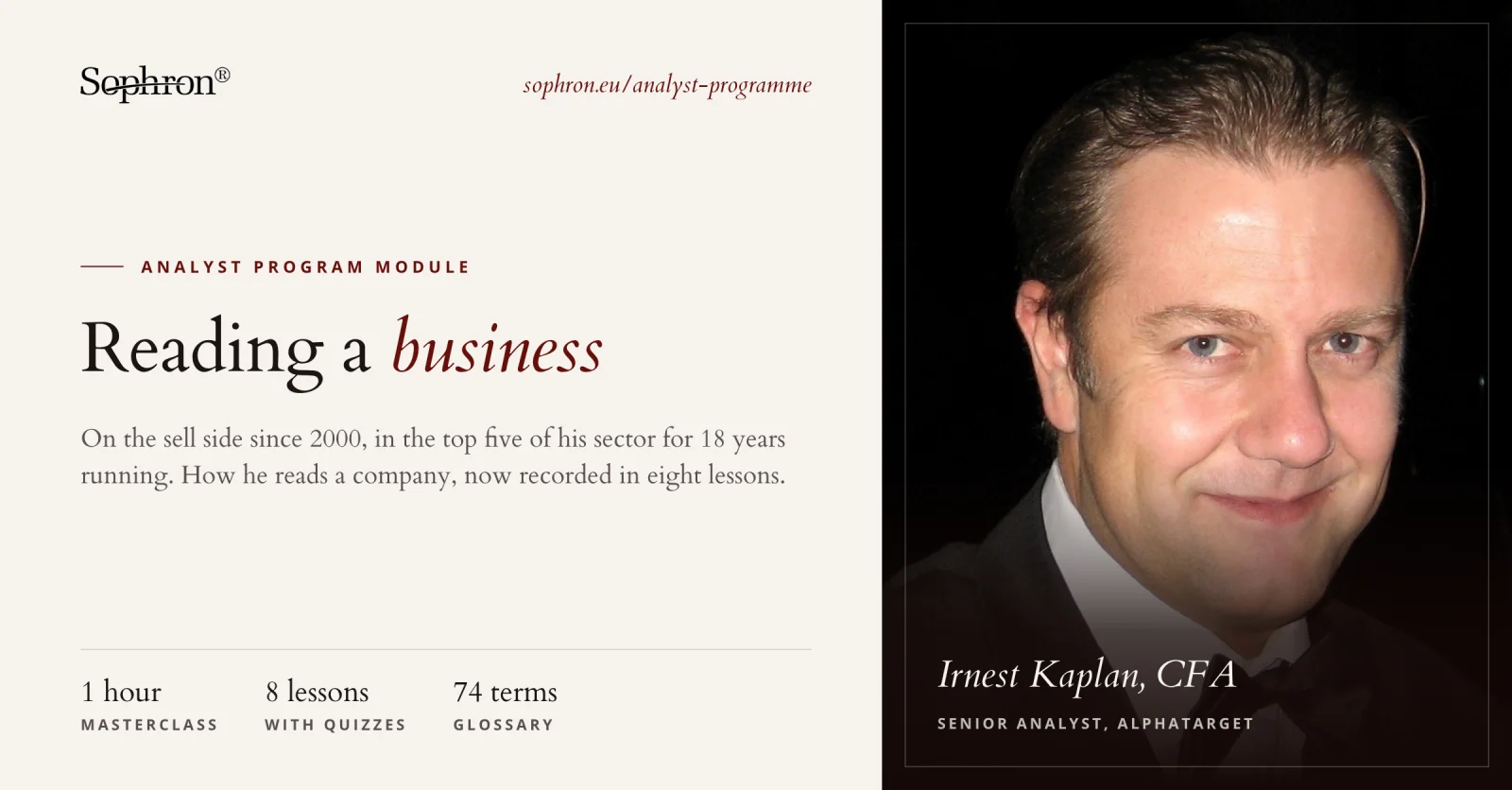
Reading a business, with Irnest Kaplan, CFA

What does an experienced analyst look at before opening a company's accounts? A course made in collaboration with technology analyst Irnest Kaplan, CFA, on the checks he runs on every company: four questions before the numbers, revenue growth, gross margin, cash flow, debt and stock-based compensation, return on capital, and the moat and management that decide how long good returns last. Then you run his one-page check on a listed company.

Irnest started on the sell side at Société Générale in South Africa in 2000 and has run his own research consultancy since 2003. He has been in the top five of his sector for 18 years in a row and is now a senior analyst at AlphaTarget.

It is a module of its own: finish the lessons, hand in an equity proposal that applies his one-page check, and earn the Sophron® Certificate in Reading a Business with Irnest Kaplan.

LinkedIn The module page →
Reading a business, a Sophron Analyst Program module with technology analyst Irnest Kaplan, CFA: on the sell side since 2000, in the top five of his sector for 18 years running.
Ten lessons: the one-hour masterclass, seven written lessons with tests, an exercise and the reference pages, with a glossary of 74 terms.

Macro Analyst seat · module with certificate

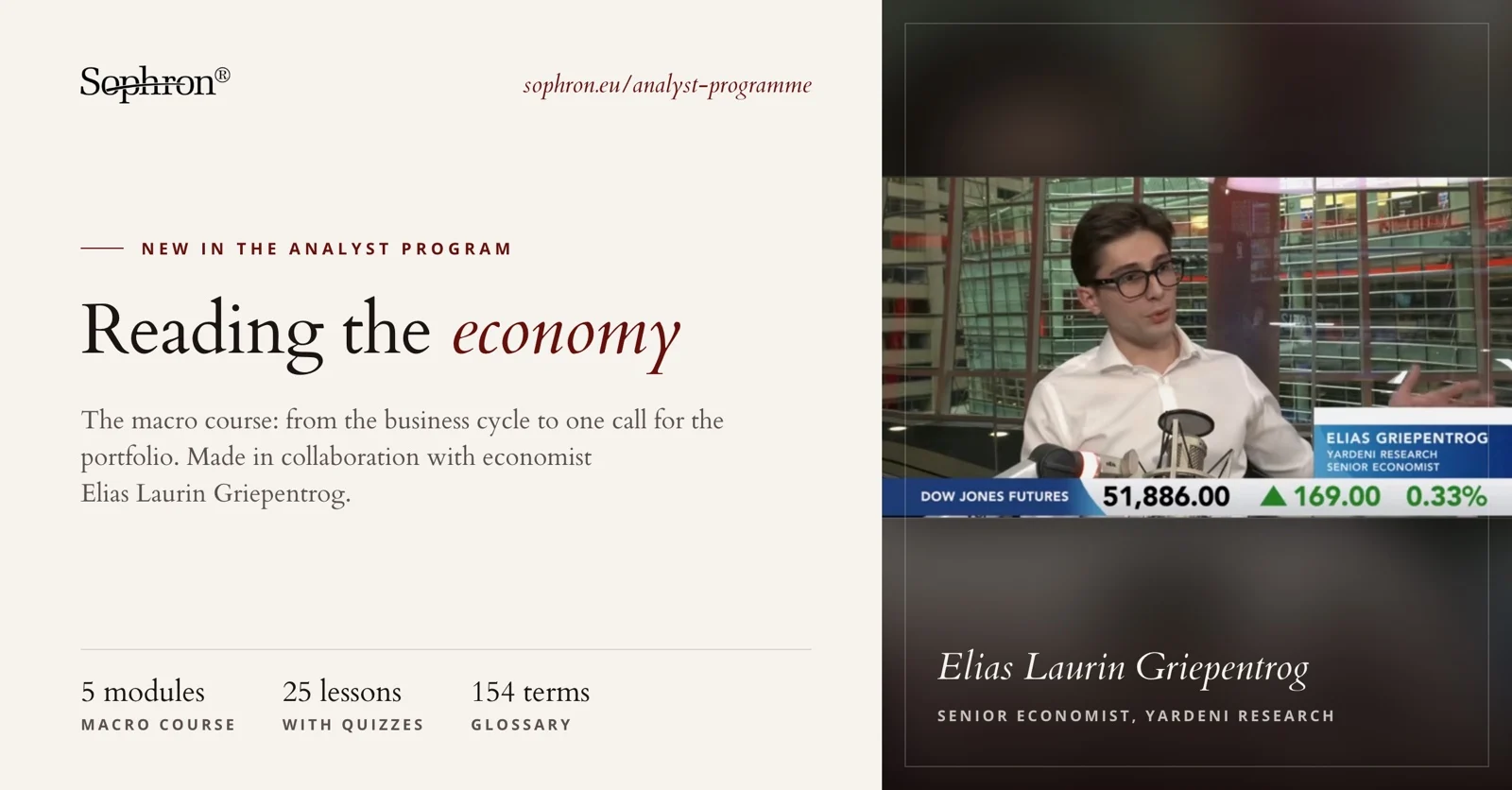
Macro Analysis with Elias Laurin Griepentrog

Where is the economy in its cycle, and what does that mean for every sector in the book? Macro Analysis works through the business cycle, the indicators that lead it and the macro tracker, central banks, rates and inflation, and how one call on the economy reaches the portfolio. Then you write the desk's phase call in five parts, from your own tracker.

Elias Laurin Griepentrog is a Senior Economist at Yardeni Research, where he co-writes its commentary on the US economy, the Federal Reserve and bond markets, and a Macroeconomic Analyst at Kraft Heinz in Amsterdam. The course was made in collaboration with him.

The Macro Analyst follows it as their seat module. Everyone else on the program can take it as a module of its own and earn the Sophron® Certificate in Macro Analysis with Elias Laurin Griepentrog.

LinkedIn The module page →
Reading the economy: Macro Analysis, a module of the Sophron Analyst Program made in collaboration with Elias Laurin Griepentrog, Senior Economist at Yardeni Research.
Five modules, 25 written lessons with tests, and a glossary of 154 terms.

The gate

Junior to Analyst

Every analyst starts as a Junior. Progress is tracked live in the portal: every module you finish and every piece of work you file moves the ring forward. When the last one lands, the portal tells you on the spot and the desk roster shows you as an Analyst.

Junior

What you clear as a Junior, tracked in the portal:

  • All 7 Foundations modules, marked as you finish them on UMushroom
  • Sector Intelligence, a recorded module and a call where your team presents its sector work
  • Economic Moats, a recorded module and a call where your team presents its shortlist and moats
  • Reporting Instructions, a written module with tests, and your report outline before the pitch
  • The pitch evening, live with your sector team; there are no pitch videos
  • Your report, due after the pitch

Becoming an Analyst takes three things: all seven Foundations, a qualification score of 100 (out of 100, kept separate from your points; the Report & Pitch is worth 40 of it, or 35 if two teammates pitch for you, one in a team of two, once your team's report is signed off, and each other session 5, with at most one session of the cycle missed; a committee seat earns the 40 by presenting its seat report, once Sophron® signs it off), and your track's final step. In Amsterdam that is the pitch, your own or two teammates'. On the online desk, what qualifies you is the Foundations, your team's report once Sophron® signs it off, attending the live pitch (your own pitch counts 40, two teammates pitching for you 35; a committee seat earns 40 by presenting its seat report, once Sophron® signs it off), and at least two of the other three calls: Sector Intelligence, Economic Moats and the Revision.

Analyst

The portal promotes you once your Foundations are complete, your qualification score reaches 100 and your track's final step is done, and from then on:

  • The Junior track closes. Your journey becomes the desk cycle.
  • You choose again at every round, as a returning analyst.
  • You carry the Analyst badge on the desk roster.
  • You receive your Sophron® Certified Analyst credential in the same sign-off: when the Sophron® team signs off your team's report, it checks everything else at the same time.

The cycle

One cycle, from your choice to the Revision

The program runs in cycles, four a year, on the same calendar as the Amsterdam desk, with the same steps and deadlines. You learn from the recorded modules and present on the calls.

Track

Online desk

Join at any time with the Passport or AIC Premium; a seat comes through the selection pool. Calls on Google Meet, the same cycle and credential.

Track

Amsterdam desk

In person, in Amsterdam. Limited seats, so the desk selects at every round.

Track

Quant

Quant researcher, developer or trader: the Quant Program is its own desk, online from anywhere and by selection, with team projects that run at least one cycle. You take part in it or on an Analyst Program desk in a cycle, not both.

You choose your track and up to three seats in the portal at every round. The selection pool is the only way between Amsterdam, online and quant, unless you ask Sophron.

Who can join
Online: anyone, at any time, with the Sophron® Passport or AIC Premium; a seat comes through the selection pool. Amsterdam: apply for free, pay only if selected
Rounds
Join any time, then choose at every round in the portal: online, open to everyone, or Amsterdam, by selection. The calendar in the portal shows each round's dates.
Sessions
Recorded modules, and the calls where you present
The work
Filed for the calls, an outline, then your report
Final step
The pitch evening, then your report
Seats
3 per sector desk

The steps run in this order. The dates of each cycle are in the portal.

  1. Stage 01
    Program IntroductionCall
    Before the cycle Online, for both desks · an open session, visible to everyone
    How the program works, how a cycle runs, and how the round choice works. The selection pool opens when it ends.
  2. Stage 02
    Your choice and the division
    After the introduction In the portal: the pool opens after the introduction, then closes; the desk divides and you see your place
    Every round you choose in the portal: take part or sit the round out, Amsterdam or online, and up to three seat preferences, in order: each is a role, and for a sector seat its sector (for example 1. Sector analyst, Energy; 2. Sector analyst, Financials; 3. Risk Manager). You click them on a board of every seat on your desk and can change them until the choice closes. The desk then places everyone, and you see your place in the portal and by email. If you do not choose in time, you sit that round out and can choose again for the next one.
  3. Stage 03
    Revision, sharedCall
    Start of the cycle The closing Revision of the cycle before · your review of the book
    The desk goes over the committed book with the teams that are finishing: the Portfolio Manager, the Risk Manager and the Macro Analyst take you through the profit or loss, what drove it, the risk and what to watch.
  4. Stage 04
    Sector IntelligenceCall
    After the Revision Recorded module, then a call · your team presents
    Screen the sector in Finviz and build the team's sector template and scorecard, with a shortlist of at least six names, so you start from a defensible universe instead of a blank page.
  5. Stage 05
    Economic MoatsCall
    After Sector Intelligence Recorded module, then a call · your team presents
    Competitive advantage: the 7 Powers, tested against the numbers. Your team's Moat Scorecard on the shortlist and the one ticker your team will write on and pitch. Each team files one form, every team sees the others' picks, and tickers lock, so no two teams cover the same name.
  6. Stage 06
    Report outlineDue
    After Economic Moats Before the pitch · in the portal
    Newcomers pass the Reporting Instructions, a written module with tests. Every team files a short outline: the ticker, the thesis in two lines, the valuation method, and what is still missing.
  7. Stage 07
    Pitch eveningRequired
    After the outline Live · on Google Meet
    Each sector team pitches live, five minutes, then questions, and each committee seat presents its seat report of the cycle. The pitch is required, and there are no videos.
  8. Stage 08
    Your reportQualifies
    After the pitch In the portal
    You write the report in the portal, with the feedback from the pitch in it, and it counts once the Sophron® team signs it off. Whether the name goes into the book is the desk's vote. For the credential you need the Foundations, this report, your own live pitch and two of the other three calls. It is issued in one sign-off: when the Sophron® team signs off your team's report, it checks your whole record at the same time.
  9. Stage 09
    AllocationVote
    After the reports In the portal, no call
    One vote on the whole book. Everyone votes a weight from 0 to 10%, with a low and a high price target, for each name the desk holds and each new name whose report Sophron® signed off; 0% on a holding is a vote to sell it. The Portfolio Manager or the Program Director commits it, which places the trades.
  10. Stage 10
    RevisionCall
    After the vote Shared with the new teams of the next cycle
    The desk goes back over the cycle: the Portfolio Manager, the Risk Manager and the Macro Analyst take it through the committed book. There is no vote. Then the cycle closes, and its work stays readable as your track record.

The year

Four cycles, a choice at every round

The same calendar on both desks. Every date is in the portal: open your Journey.

Every round
You choose, the desk places

You can join any time. Before each round you choose in the portal: take part or sit the round out, Amsterdam or online, and your seat preferences. The desk then places everyone. The Program Introduction is an open session for both desks.

Re-forms
Between cycles

Analysts who continue choose again for the next round, with no second onboarding, and newcomers choose too. Each round opens with its introduction, then the choice, then the division.

The close
Pitch, report, vote, Revision

The pitch, live; then your report; then the Allocation vote; then the Revision, shared with the new teams of the next cycle.

Seat reports
Every cycle

The online desk's own committee files its Portfolio Update, Risk and Macro reports with the team reports, after the pitch of every cycle. Each seat presents its report at the pitch, as the teams present theirs.

Next cycles: A new cycle starts each season. Each opens with its Program Introduction, then the choice, then the division.

Seats you can hold

Choose the seats you want to sit in

Every round you click up to three seats you want, in order, on a board of every seat on the desk, and you can change them until the choice closes. The desk then places everyone in all seats. Risk and Macro are open to Juniors and Analysts alike, and Portfolio Manager is the senior seat. Every seat you hold is recorded on your credential as a role held.

Equity Sector Analyst
4 sector desks · 3 seats each

The default seat. Take one GICS sector, screen it, pick a name, write the thesis you pitch.

You produce: the sector work with your team, then a company report and the team pitch each cycle.
Risk Manager
Committee · up to 2 seats · placed by the desk

The independent check. You review every idea for concentration, factor exposure and drawdown, and you flag a name that breaches a hard limit, so the desk sees it before it votes.

You produce: a comment on every proposal, plus the Risk Report of the cycle, presented at the pitch.
Macro Analyst
Committee · placed by the desk

The wider view. You give each idea its rates, credit and FX context, so a single name is read against the backdrop rather than on its own.

You produce: a macro overlay on the cycle, plus the Macro Report of the cycle, presented at the pitch.
Portfolio Manager
Senior seat · 1 seat · placed by the desk

The final step. You or the Program Director commit the desk's vote result, which places the trades. You own the mandate: you post any desk limits beyond the 10 percent cap and open a rebalancing vote when a position is above it. The vote sets the size, not you.

You produce: notes on the record with each committed vote, plus the Portfolio Update Report of the cycle, presented at the pitch.

Commodities Analyst is not a seat on the online desk. Quant is its own desk, by selection: see the Quant Program.

The deliverable

What a signed-off report looks like

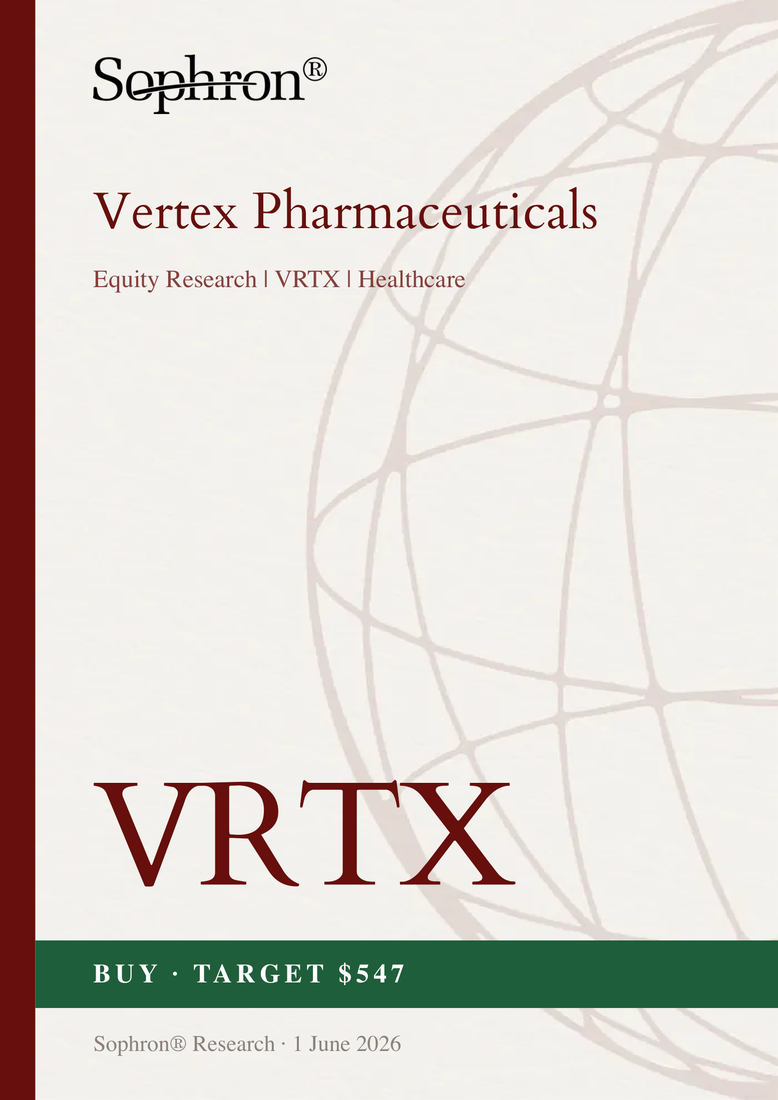
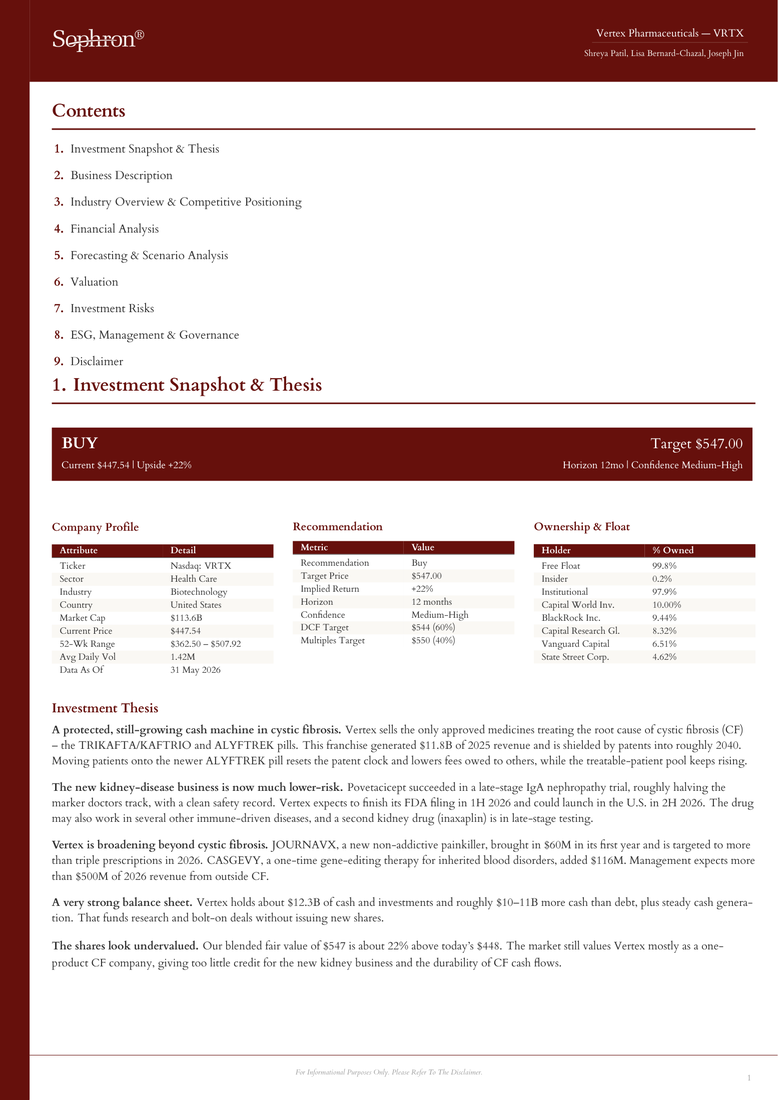
An example of the method: the Vertex Pharmaceuticals (VRTX) report by the Health Care team, written up, defended and signed off before it entered the book.

Cover of the Vertex Pharmaceuticals research report
The cover: company, team and date.
Buy rating, $547 target, company profile and the investment thesis
The call: rating, target and the thesis.
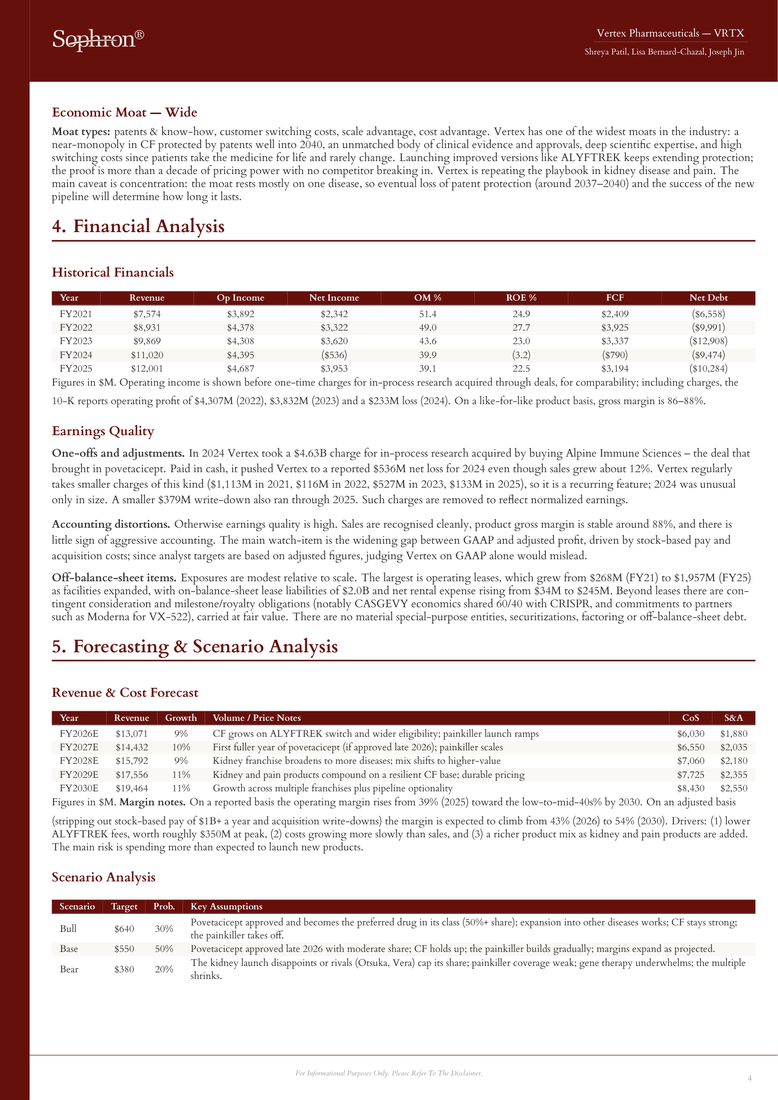
Five years of financials, a revenue forecast and bull, base and bear scenarios
Financials, forecast and the bull, base and bear cases.
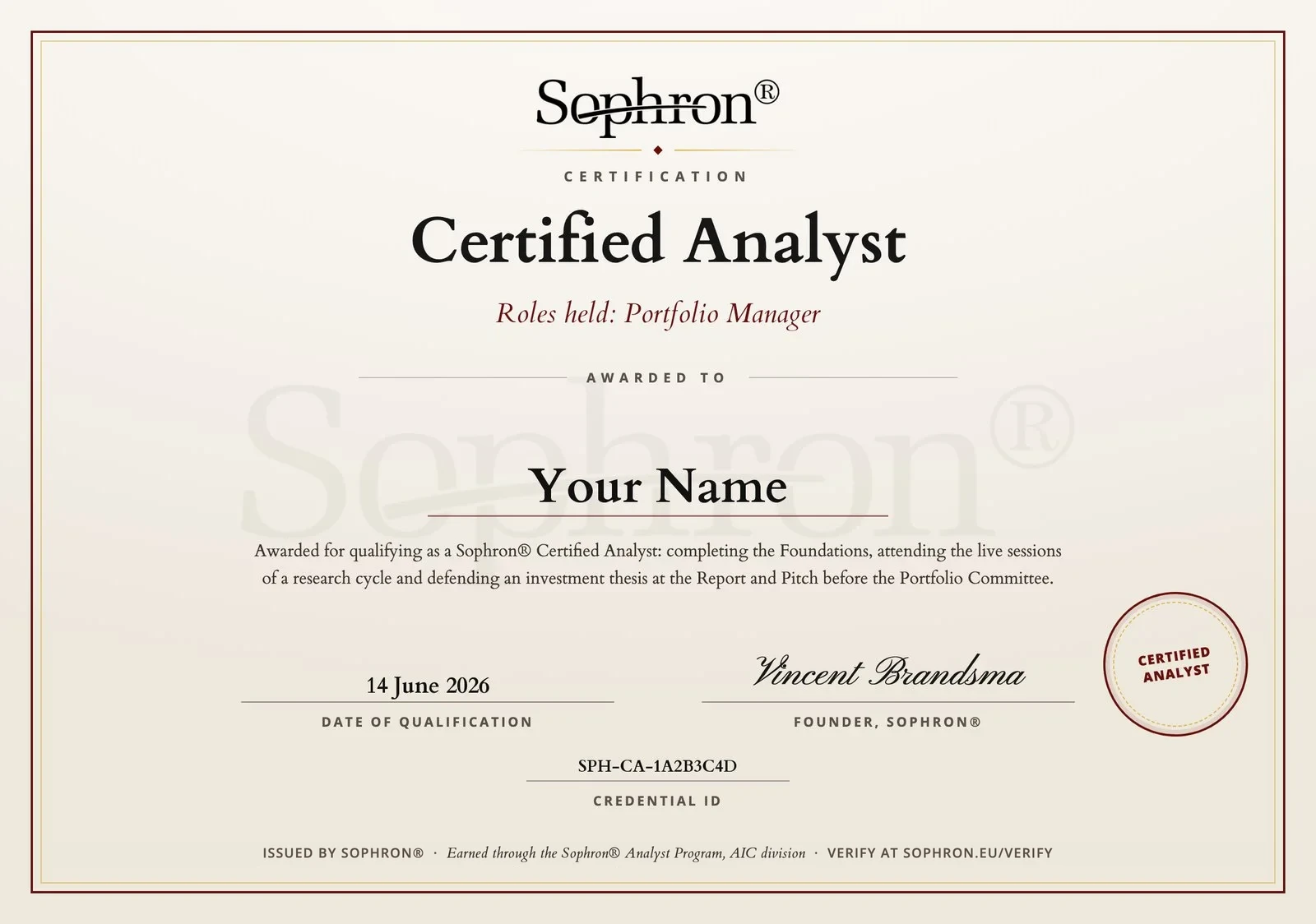
The Sophron® Certified Analyst credential, with the roles held and a credential ID The Certified Analyst badge
The credential, in the public registerThe badge on your Sophron® profile

The credential

Sophron® Certified Analyst

You earn it online and Sophron® awards it. Sophron® sets the standard; the program is how you meet it. The credential names the work, not attendance: the research, the thesis, the pitch and the seats you held on the desk.

  • Earned, not given. Once your Foundations are complete, your qualification score reaches 100 and your track's final step is done, you receive it when the Sophron® team signs off your team's report and checks your whole record in the same step. It is never automatic. On the online desk, what qualifies you is the Foundations, your team's report once Sophron® signs it off, attending the live pitch (your own pitch counts 40, two teammates pitching for you 35; a committee seat earns 40 by presenting its seat report, once Sophron® signs it off), and at least two of the other three calls: Sector Intelligence, Economic Moats and the Revision.
  • Verifiable. Every credential carries its own credential ID and is listed in the public Sophron® certification register, so an employer can check it in seconds.
  • On your LinkedIn. Download it as a PDF or PNG, or add it to the certifications section of your LinkedIn profile, with your name and credential ID on it.
  • Your roles are on it. Portfolio Manager, Risk Manager or Macro Analyst: every seat you hold is added to the same credential as a role held, once that cycle's seat report is approved. The same sign-off counts as your pitch credit and checks your whole record.
See the certification register

A look inside

The desk, from the inside

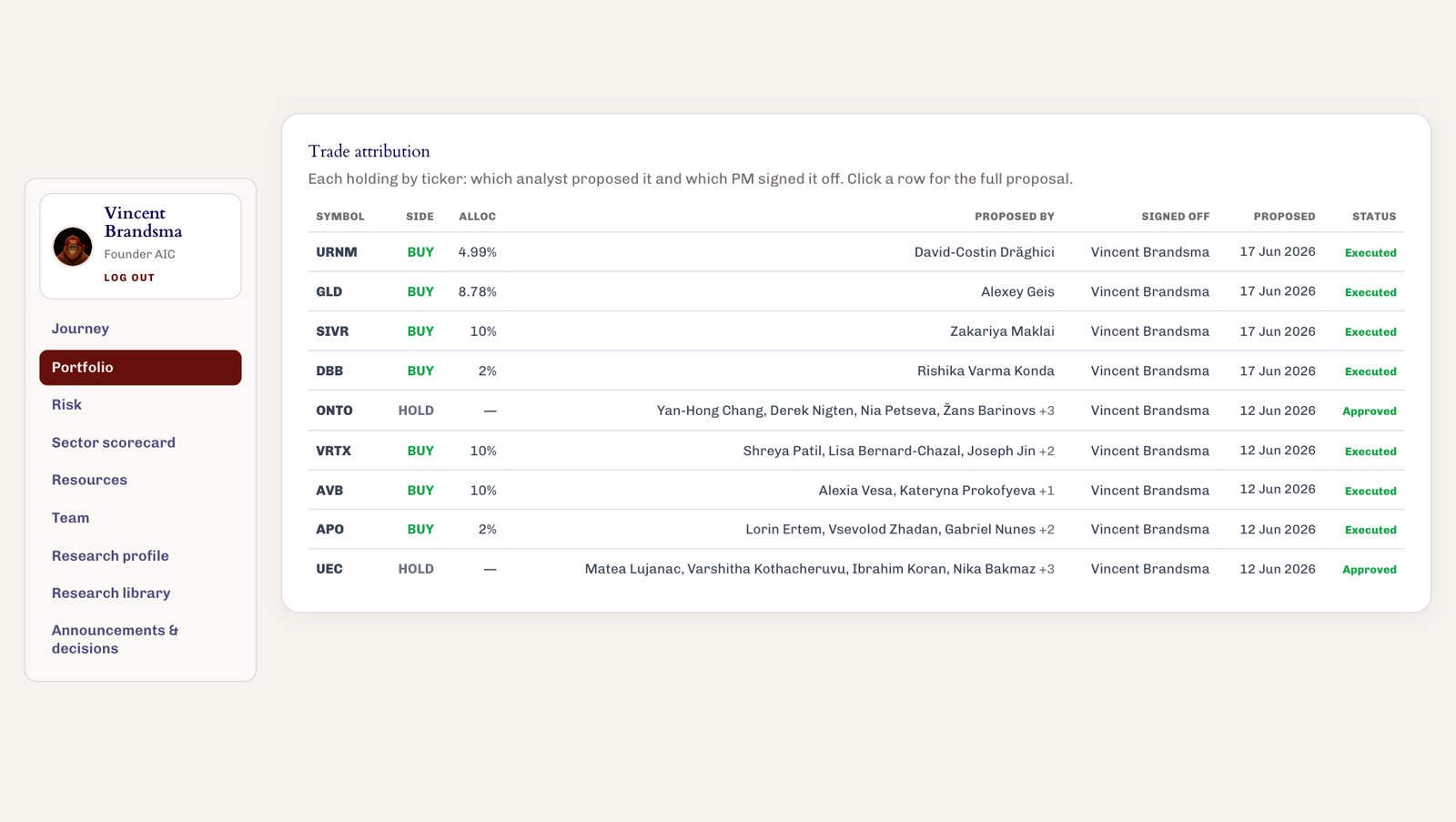
Screenshots from the analyst portal: every holding traced to its analysts, and the desk arguing each one out.

Trade attribution: each holding with the analysts who proposed it and the Portfolio Manager who signed it off
Every holding, who proposed it and who signed it off.
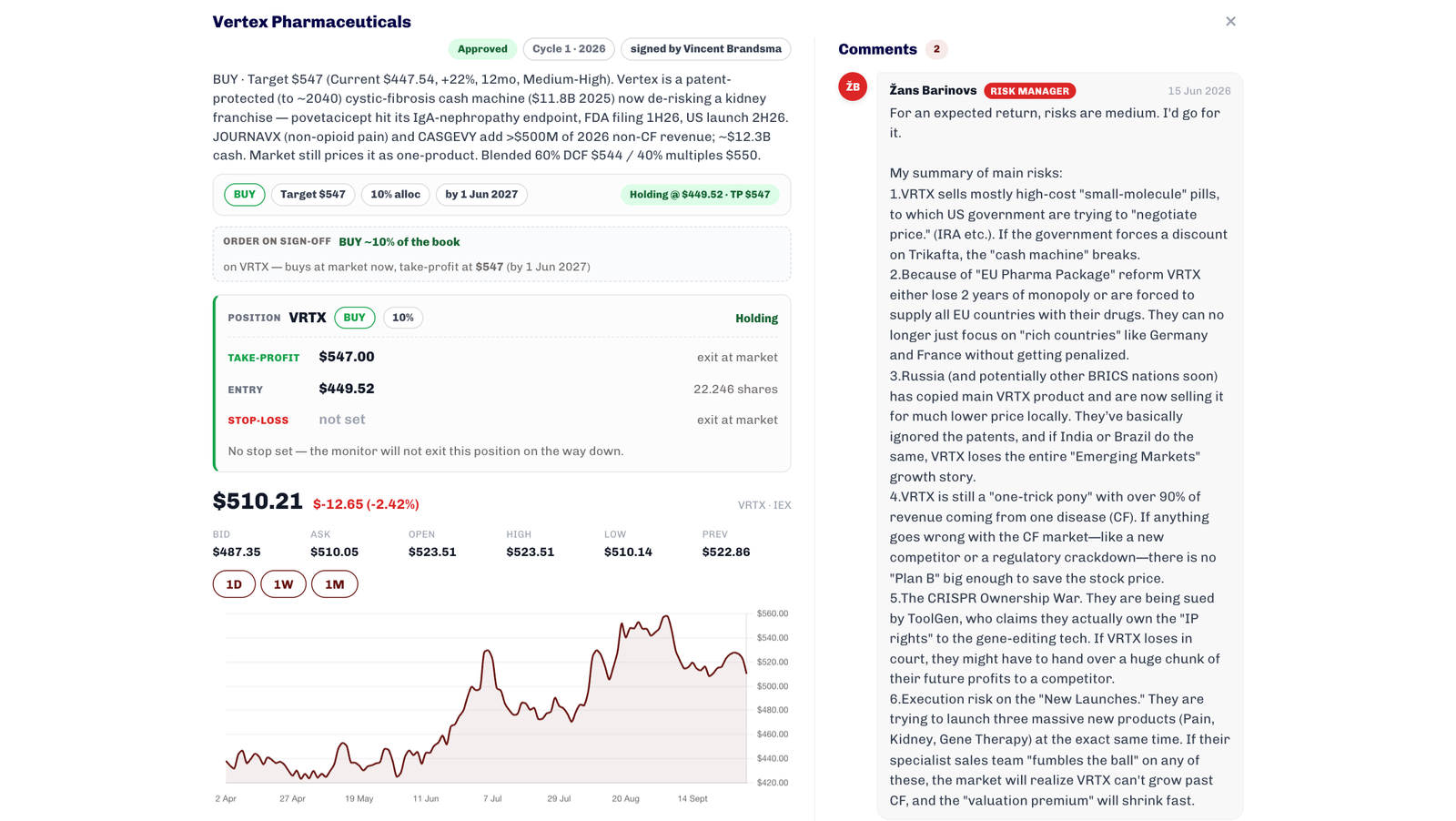
The Vertex proposal: the thesis, the position and the Risk Manager's comment
One proposal: the thesis, the position, and Risk pulling it apart.

Journey

Every stage and deadline in one chain, with a progress ring and your points.

Research

Write your report in the portal, section by section; Sophron® signs it off, and every report is filed under its proposal.

Portfolio & Risk

A live paper book on a broker paper account. Approved equity ideas arm at the next open, with the target as take-profit.

Team & calendar

The desk roster by sector, the calendar with file submissions, and every announcement from the desk.

The output

Three theses, examples of the method

Every idea in the book starts as an analyst report, is pitched, and carries the Portfolio Manager's notes on the record. Here are three as they sit in the portal: a commodity call, a company call, and one that went through the full committee.

DBB
Aluminium (LME)
Rishika Varma Konda · Commodities desk
BullishSigned off2% allocation
LME aluminium $3,675/t (+50% year on year, 6 to 12 months, Medium). A rally driven by supply shocks: European and African smelter outages, Gulf disruption from the Iran conflict, constrained Chinese offset, and a Guinea bauxite export curb due June 2026. EU deficit 5.6Mt, global 2.2Mt. Directional view, no numeric price target. Research only: no listed equity on the paper book, so no automatic order.
Portfolio ManagerVincent Brandsma

Allocation cut to 2% per Black-Litterman, the floor. The report is a directional bullish call with no numeric price target, so the model has no view return to act on and defaults it to the floor. A numeric price target would let the model size it on conviction rather than defaulting.

Execution note. Implemented via DBB (Invesco DB Base Metals). Take-profit $27.51 applies the report's move to DBB at $25.57. DBB is a base-metals basket (aluminium, zinc, copper), not pure aluminium, so this is directional.

APO
Apollo Global Management
Lorin Ertem, Vsevolod Zhadan, Gabriel Nunes · Financials team
BuySigned offTarget $134
Apollo's edge is Athene: $300B+ of captive, low-cost insurance capital generating $3.4B of recurring spread income, an advantage Ares and Carlyle cannot match. Trades roughly 22% below the team's $134 sum-of-parts despite a record FY25 ($8.38 ANI/share). Private-credit tailwind (record $309B originated, 80% investment grade), AUM +24.9% to $938B, a $10B FRE target by 2029, plus a new retail and wealth growth line. DCF $116 (30%) / multiples $134 (70%).
Portfolio ManagerVincent Brandsma

Allocation cut to 2% per Black-Litterman. Despite the buy call, the $134 target implies almost no upside from the current price, so the model gives APO no edge and drops it to the floor. The target may simply be a little stale relative to where APO trades now, which would explain the near-zero view return.

VRTX
Vertex Pharmaceuticals
Shreya Patil, Lisa Bernard-Chazal, Joseph Jin · Health Care team
BuySigned off10%, the cap
Target $547 (current $447.54, +22%, 12 months, Medium-High). Vertex is a patent-protected cystic-fibrosis business ($11.8B in 2025) now de-risking a kidney franchise: povetacicept hit its IgA-nephropathy endpoint, FDA filing 1H26, US launch 2H26. JOURNAVX (non-opioid pain) and CASGEVY add more than $500M of 2026 non-CF revenue, with about $12.3B of cash. The market still prices it as one product. Blended 60% DCF $544 / 40% multiples $550.
Risk ManagerŽans Barinovs

For the expected return, risks are medium. I'd go for it. Main risks: US drug-price negotiation on high-cost small molecules; the EU Pharma Package costing two years of monopoly or forcing supply across all member states; a copied product already selling locally in Russia, with India or Brazil as the real tail risk; over 90% of revenue still from one disease; the ToolGen suit over CRISPR ownership; and execution risk on launching three products at once.

Portfolio ManagerVincent Brandsma

Allocation set to 10% per Black-Litterman on an equal-weight prior. VRTX is the desk's strongest buy view, an implied annualised return to the $547 target of around +24% at 60% confidence, so the model tilts it far above the 10% prior, about 30% unconstrained. Held to the 10% per-position cap. Target $547 stays the take-profit.

That thread is the point of the program. An analyst writes it, Risk pulls it apart, the desk votes on the size, the Portfolio Manager or the Program Director commits it and puts the reasoning on the record, and only then does it become a position.

Join the desk

Ready to write your first thesis?

A few hours a week, in Amsterdam or wherever you are. The Amsterdam desk is free to apply: you only pay if the desk selects you. You can join the online desk at any time, €25 a year with the Sophron® Passport, or included in AIC Premium; a seat comes through the selection pool. Then press Join the program on your portal page and your portal opens at once; requesting the Sophron® group on UMushroom for your Foundations is one of your first steps inside, accepted daily at 11:00.

The Sophron® Passport: €25 a year (incl. 21% VAT), renewing each year from the day you join; cancel any time and your access runs to the end of the paid year. Members of the Amsterdam Investment Club pay nothing extra: the program is included in its Premium membership, €15 a year (see AIC Premium). You sign in with your Sophron® account.