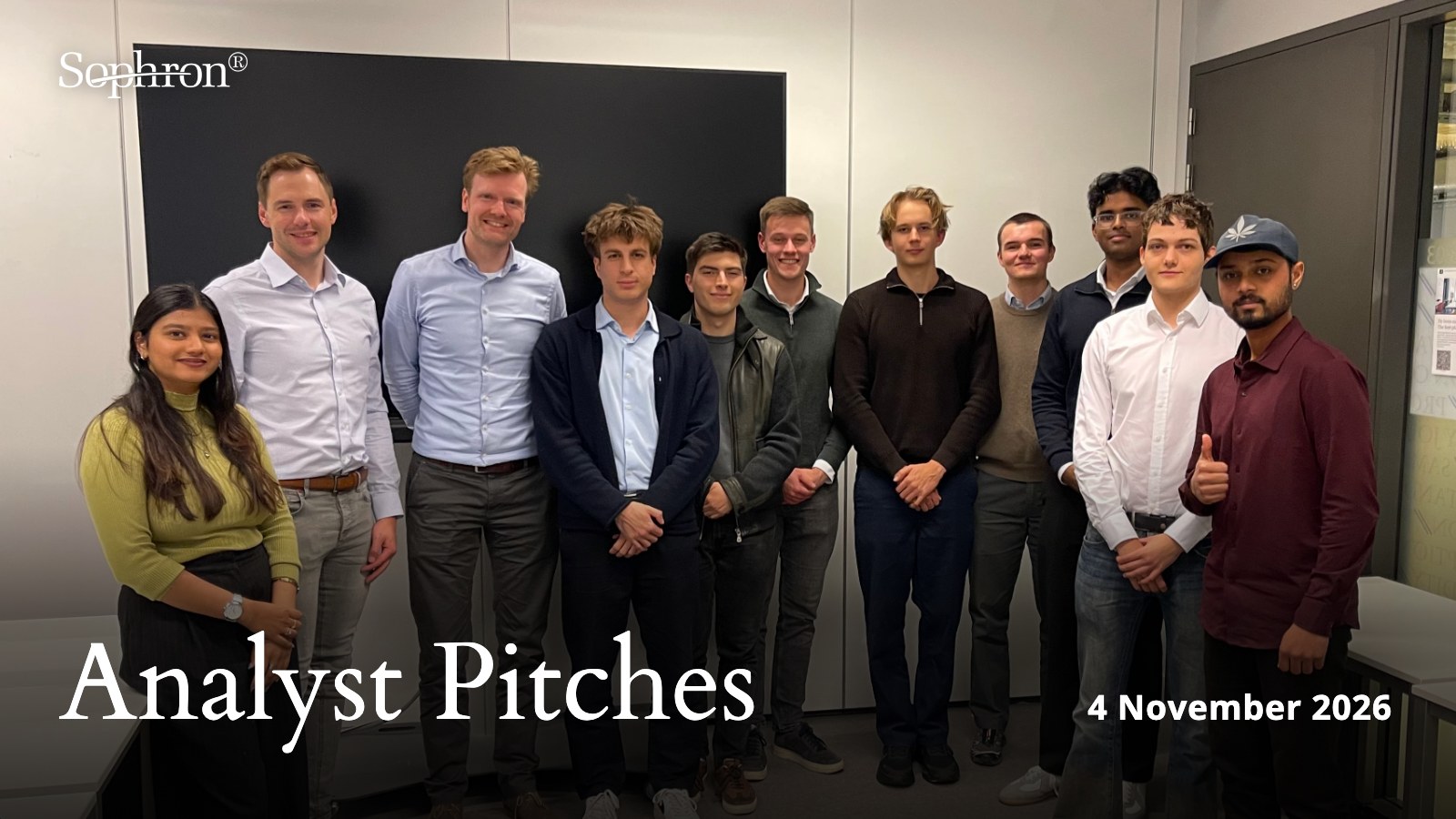
The evening
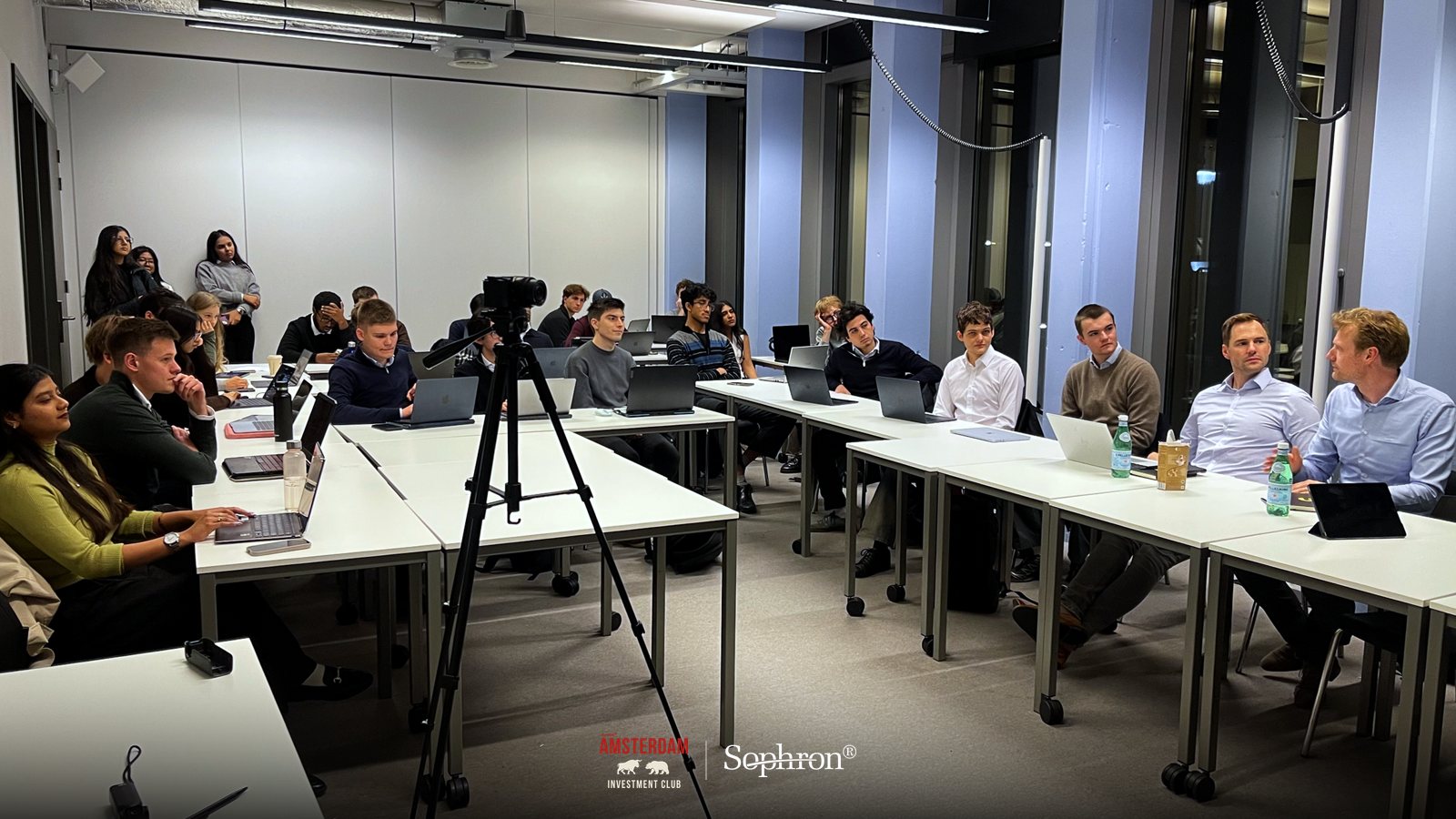
At the end of each cycle, every desk of the Sophron® Analyst Program writes a report and pitches it. On 4 November the Amsterdam desk did this in a room at the University of Amsterdam, in front of two judges from the industry. Macro had seven minutes; every other desk had five minutes to pitch and a few more for questions, and most of the questions ran longer than the pitch.
The US midterm results had come in the day before, after most reports were written. The judges used that more than once: if the result changes your view, say how.




The twelve calls
| Desk | Name | Call | Target, as pitched |
|---|---|---|---|
| Macro | US outlook | Late cycle | Overweight energy and tech |
| Energy | Chevron | Sell | $193, from $228 |
| Commodities | Brent crude | Down | $100 a barrel in three months, from $108.60 |
| Commodities | Gold | Short | About 2% of the portfolio |
| Communication Services | Alphabet | Buy | $294 |
| Consumer Staples | Scandinavian Tobacco Group | Buy | DKK 102, plus the dividend |
| Financials | American Express | Buy | $360, from $324 |
| Health Care | Doximity | Hold | $26.81, from $32.76 |
| Industrials | Caterpillar | Buy, small weight | $690 |
| Information Technology | SK Hynix | Buy | $208, from about $150 |
| Materials | Rio Tinto | Buy | $82 |
| Utilities | Duke Energy | Hold | $128 |
The targets are the analysts' own, as pitched on 4 November 2026 from reports dated a few days earlier. Prices have moved since. This is student research, not investment advice.
The pitches
The Macro desk calls a late cycle
Macro desk · André Lindqvist · Rishika Varma Konda
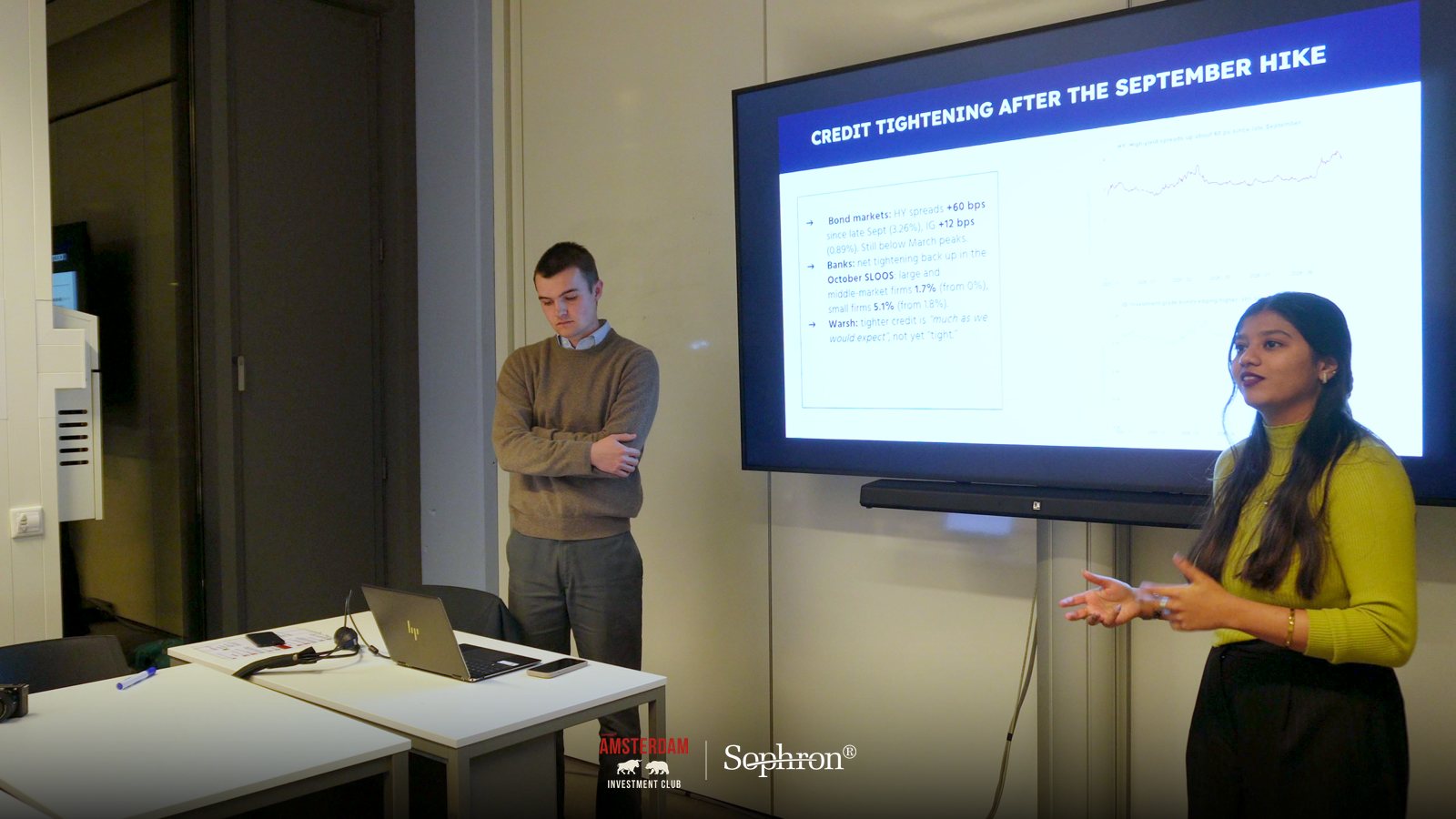
The desk reads the US economy as late cycle, with moderate conviction.
The pitch
- High yields and sticky inflation, with energy prices up about 20% over the year. Core PCE, the Fed's preferred measure, is steadier but still above the 2% target.
- Investment is strong, carried by the AI build-out, but it is not reaching workers: payrolls and real wages are cooling and consumer confidence has dropped.
- The Fed raised rates in September and held in October. Credit is tightening: spreads widened after the hike and banks report stricter lending.
- Positioning: overweight energy and tech. What would change it: Brent below $90, the Fed holding in December, or core PCE below 3%.
Questions from the judges
- You are overweight IT and overweight energy. IT usually gains from falling rates, and your energy case rests on higher inflation. What would make you drop the IT overweight?A sustained rise in yields. A 10-year yield above 5.25% for a longer period would be hard on tech, and it is not far off.
- Has the US midterm result changed your macro view?Yes. The report was written on 30 October and markets were already moving. The Middle East and how much power the president keeps both look different now, and the desk had not had time to work that through.
- Which sector does the result hit most?Probably IT, if the new Congress pushes back on the pace of AI spending.
The Energy desk sells Chevron
Energy desk · Kateryna Prokofyeva (desk head) · Vincent Smekens
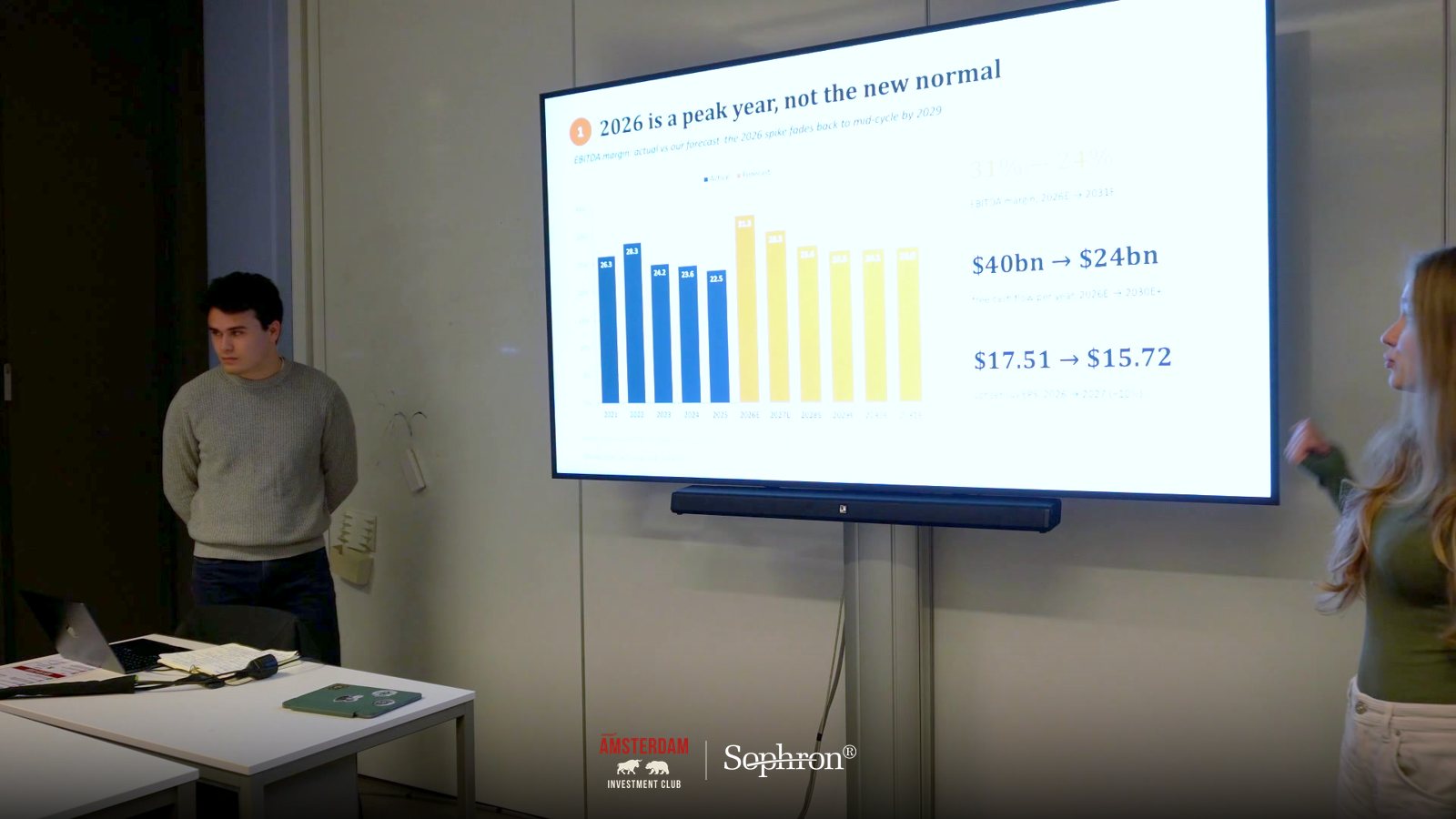
"The market is paying for a peak that won't last."
The pitch
- Sell at $228 and buy back later, with a 12-month target of $193, about 15% lower.
- 2026 profits are lifted by record margins and a temporary oil price spike, and the share price treats them as the new normal. The desk expects the EBITDA margin to fall from 31% to 24% by 2031, and free cash flow to fall with it.
- To justify today's price, Chevron would need a long-run EBITDA margin of 28.2%, close to its 2022 record. The five-year average is 25.6%. The desk used 24%, which gives $191 in the DCF, against $195 from multiples, and took the average.
- What could prove it wrong: a large power project with Microsoft for data centres, and talks with Kazakhstan over the state's share of a major oil field's revenue.
Questions from the judges
- You say Chevron is building power plants. How big is that business inside the company?Small next to oil for now. It would take many more data centres to keep the share price where it is.
- Does Chevron plan to grow that side?For now its main goals are still in oil.
- Your valuation rests on a DCF and on historical margins. Has the world not changed?It has, and that is the difficulty. A disruption in the Strait of Hormuz happens perhaps once in ten or twenty years. The history no longer reflects what is happening, but you cannot treat today as permanent either.
- A question for the portfolio, asked later in the evening: macro is overweight energy and oil prices are high, yet the energy desk sells perhaps its biggest oil stock. How do you square that?Selling the biggest oil stock does not make you bearish on the sector. You can sell one large position and take on another, without going underweight energy.
Feedback
- A judge added that a bullish view on the economy and a bearish view on energy prices do not clash: lower energy prices usually go with more industrial output and growth.
The Commodities desk calls Brent lower
Commodities desk · Abdelrahman Mohamedahmed · Filip Blazeczek · Krzysztof Gromski · Tommaso Xiang
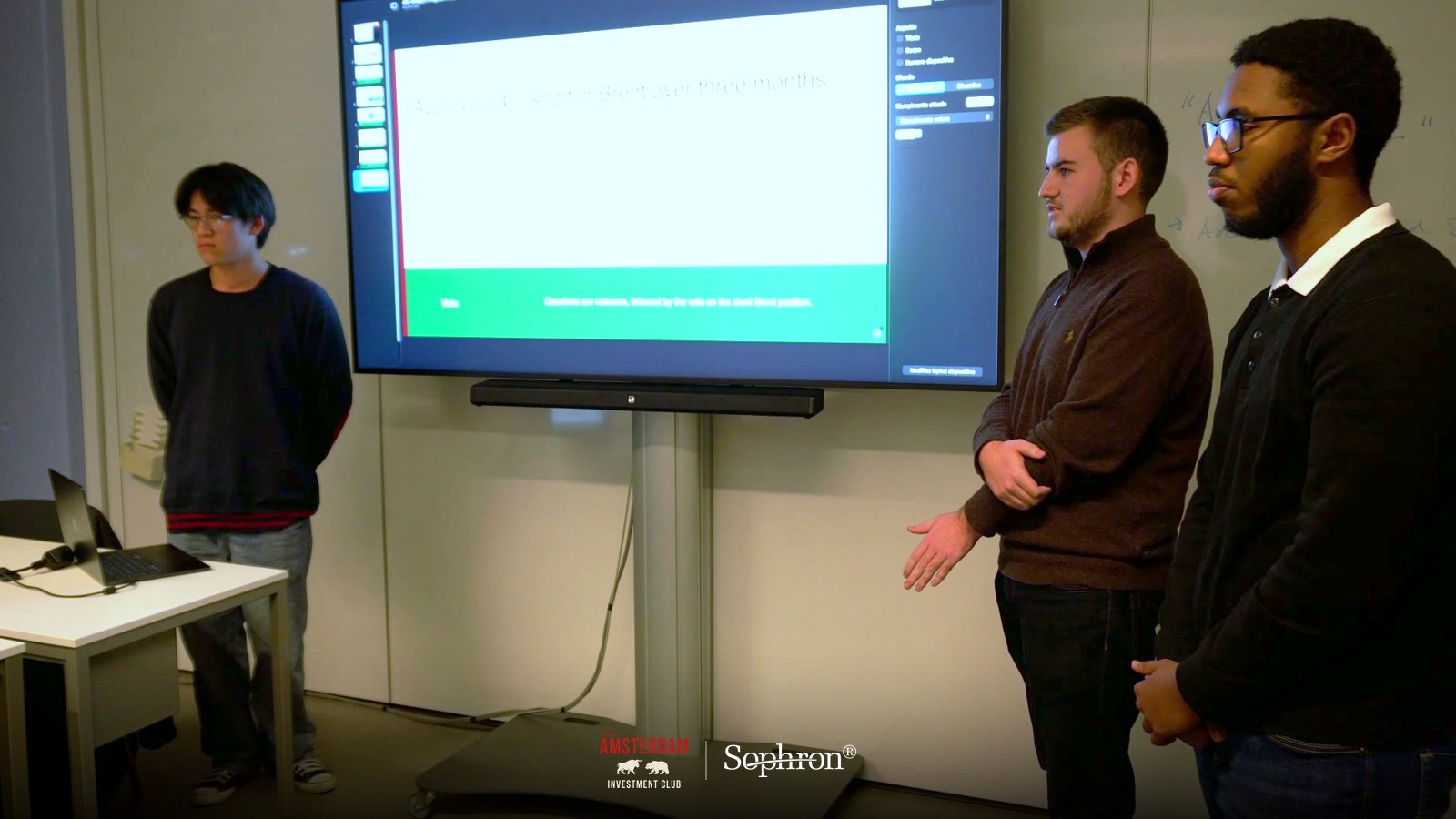
A three-month call: down from $108.60 to $100 a barrel.
The pitch
- Part of the price is a fear premium after attacks near the Strait of Hormuz and on Saudi infrastructure. Fear of a shortage moves the price before any shortage happens, so if tension eases, that premium fades.
- If shipping routes stay open and exports recover, supply worries fall. High prices also make transport and production dearer, which slows demand.
- The midterm result makes fewer strikes in the region more likely, in the desk's view. The futures curve pointed to about $99 by April.
- Three outcomes: the base case of $100, a lower price if peace talks succeed, and a higher one if they fail or OPEC+ cuts output.
Questions from the judges
- As we walked in, Brent was around $93 to $94. Do you stick with your forecast?The report is three days old and the price was about $99 at the start of the session. The election result makes the forecast more likely, not less.
- Many countries released emergency oil reserves to blunt the price rise. They must refill them now, going into winter, while supply is still tight. Is that in your forecast?No. The Strait of Hormuz carries the most weight on the price right now. Without it, winter would matter most, because demand for heating oil rises.
- How many tankers pass through the Strait of Hormuz right now, and where will that go in the next three months?The desk did not have the number to hand. It expects traffic to rise as tension eases.
- The president runs foreign policy, so Congress has little say. Will Trump respond to this loss by bombing more or less?Less, the desk expects: he will want to focus on the US to win the next elections.
The Commodities desk shorts gold
Pitched by Filip Blazeczek for the Commodities desk
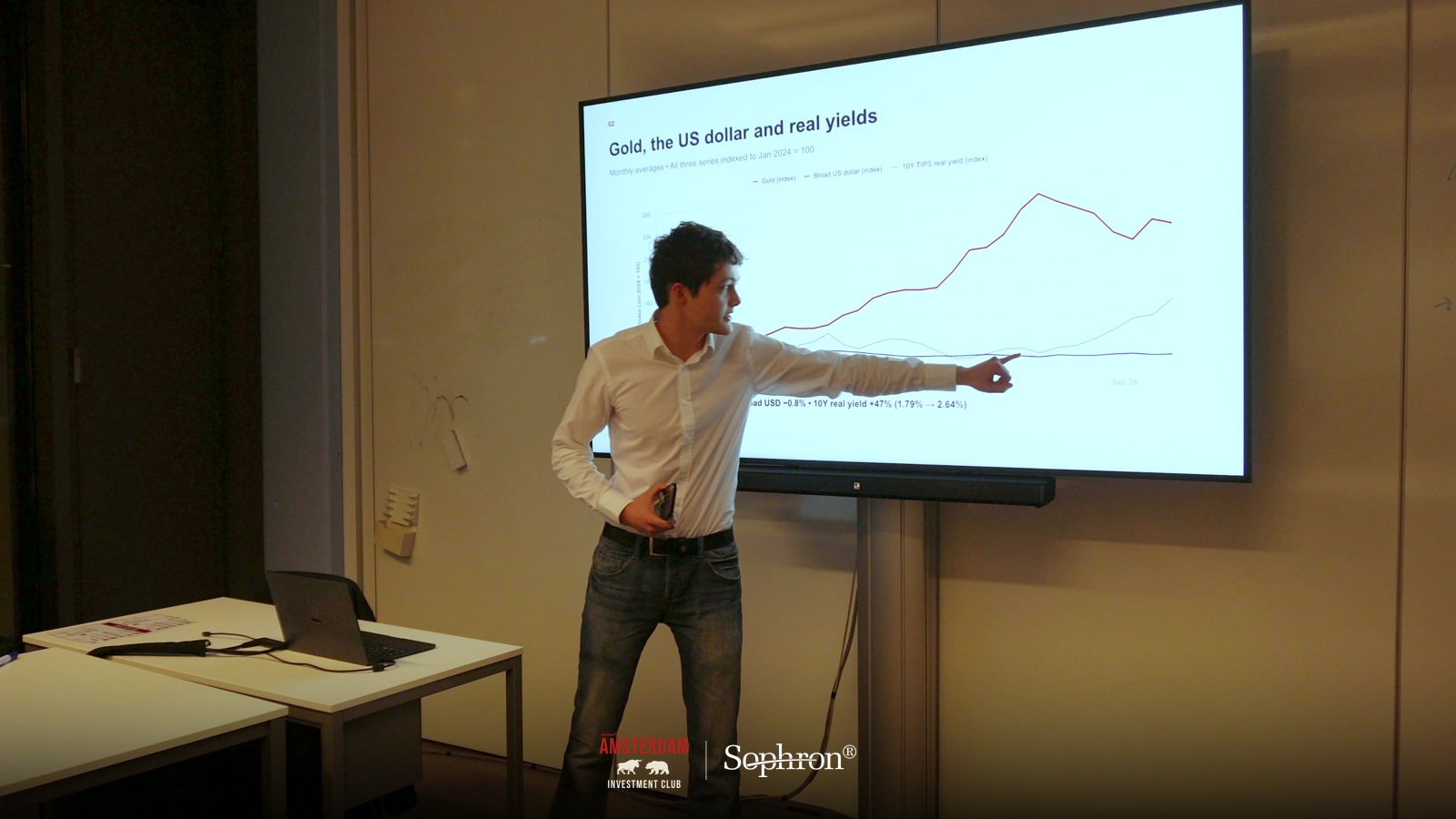
Bearish over three months, and kept small.
The pitch
- Three things move gold: real interest rates, the strength of the dollar, and geopolitical fear. When real yields rise, holding gold costs more, because it pays no interest.
- Inflation from high oil prices and a tighter Fed should lift real yields and the dollar, which pushes gold down. Ongoing tension could limit the fall.
- The trade: short COMEX gold futures, at about 2% of the portfolio, because three months is short and the call is risky. Softer inflation or a new escalation would hurt it.
Questions from the judges
- The buyers of gold have changed. Central banks now buy large amounts without much regard to price. Has demand changed for good, or is something else behind six months of falling prices?Governments are adding to reserves as uncertainty rises, so that demand is real. But it matters less than inflation expectations.
- What regime are we in: does gold trade like a currency or like a commodity right now?Today, a currency.
Feedback
- Look at the plumbing. A large share of physical gold trades through Dubai, and with the war that flow has changed. When it ends, the dynamics may change again.
- Gold has not acted as a safe haven for a year: it rises when stocks rise and falls when they fall. On the evening itself, with less tension expected in the Middle East, it was up 3%.
- Sometimes gold trades like a currency and sometimes like a commodity, and you have to spend time working out which one you are in.
- After an election there is too much noise. Give the market two weeks to settle before you read much into the moves.
The Communication Services desk buys Alphabet
Communication Services desk · Sven Homan (desk head) · Henryk Swirski
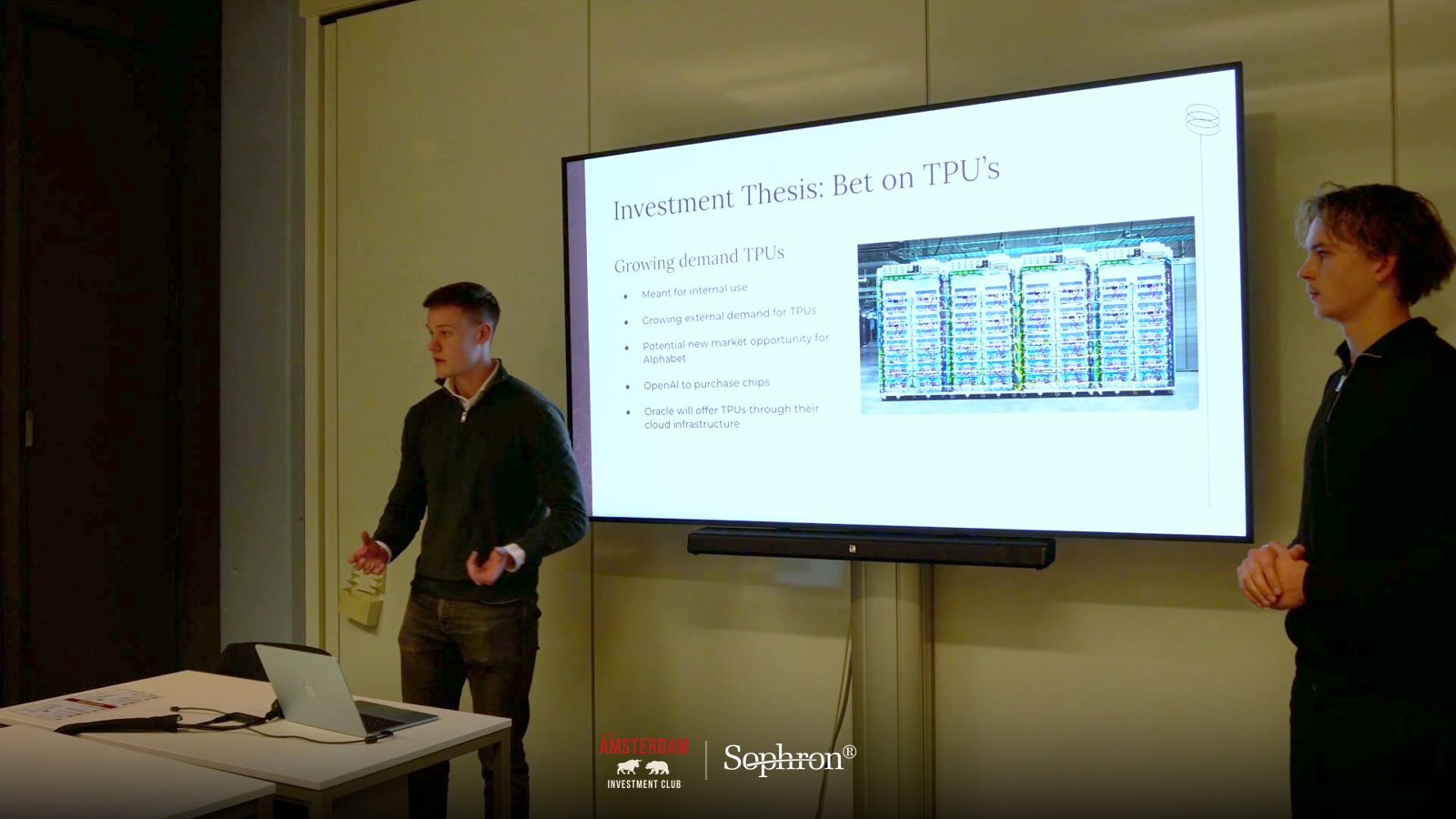
A bad trading day on missed revenue was, in the desk's view, an overreaction.
The pitch
- Buy, target $294. The DCF gave $246; the desk put more weight on P/E multiples, because heavy capex has turned free cash flow negative for the first time since the listing and a DCF punishes that.
- Google Cloud is growing faster than advertising and carries an order backlog of $561 billion. Demand for Google's own TPU chips is spreading beyond Google, with OpenAI reported as a buyer and Oracle offering them in its cloud.
- Risks: AI demand falling while capex runs at around $200 billion a year, and bottlenecks in building data centres.
Questions from the judges
- Search revenue is clicks times the price per click. There is talk that Google has been over-earning: advertisers used to pay the second-highest bid, and Google may now be charging the top one. Have you looked at that, and is it a risk?Not yet. It would be a real risk if advertisers found out, but the thesis rests on cloud and AI paying off more than the old revenue model.
Feedback
- Value Alphabet by its parts. Search is about 68% of revenue and cloud about 20%, but Waymo and the chips may one day be worth more than the rest. Each part needs its own analysis.
- Search could also go the other way: how much do you no longer Google, now that you ask an AI?
- For a growth company you need a DCF and a view of the P/E in three or four years, not last year's P/E. If you only count the next few years, most of the value is still to come.
- YouTube deserved a place in the case: one judge called it one of the best assets you can own today. And a good presentation.
The Consumer Staples desk buys Scandinavian Tobacco Group
Consumer Staples desk · Abhinav Bhowmik (desk head) · Devaanshi Singhal · Tomas Trusilo
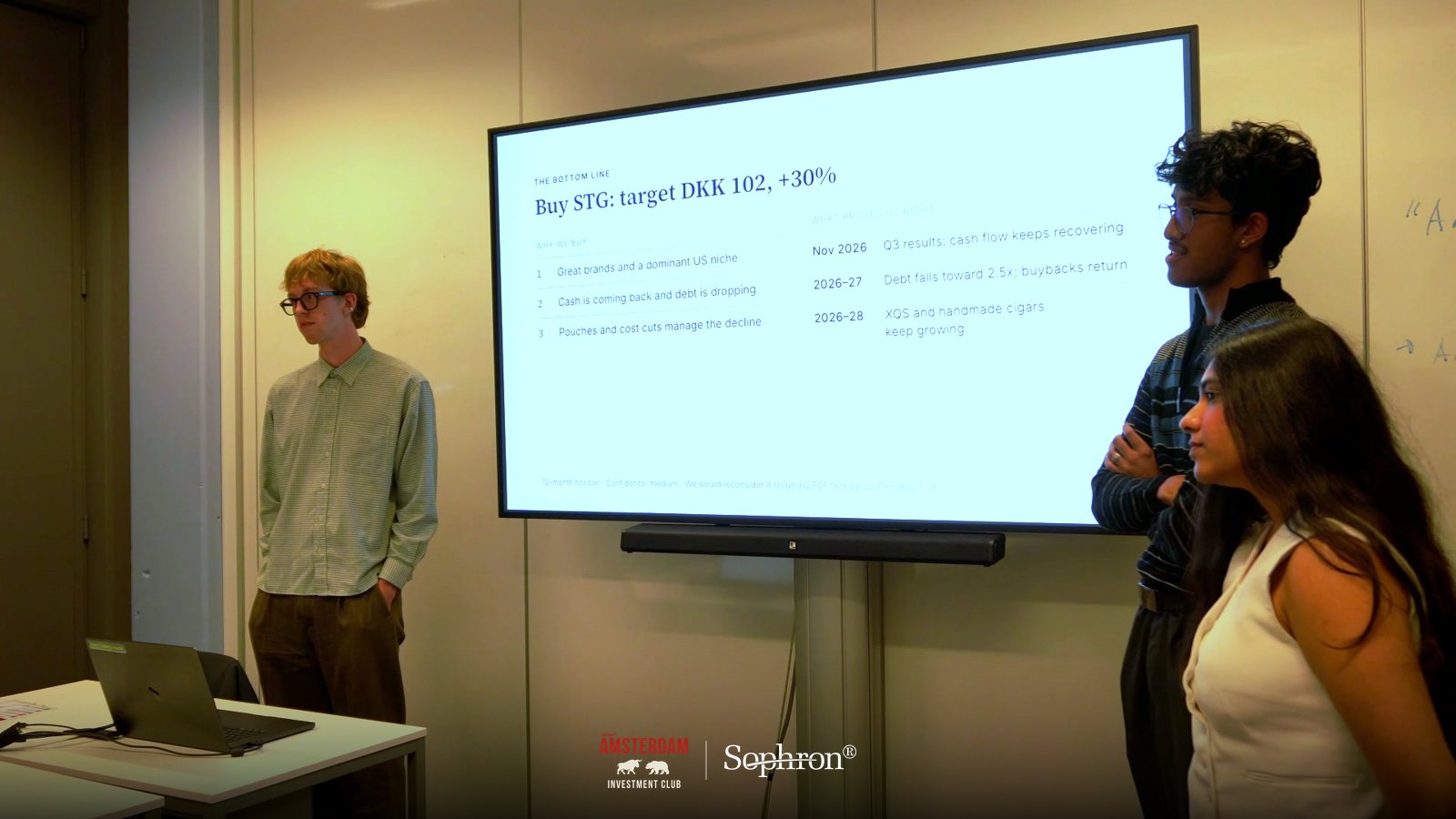
A cigar maker the market sees as stuck, with cash coming back underneath.
The pitch
- Buy, target DKK 102, with a dividend yield of 5.7% while you wait.
- An IT failure in 2025 delayed payments, and that cash is now returning. STG also sold two brands to Japan Tobacco for about DKK 1.3 billion, roughly 16% of its market value. That brings debt down towards management's target, after which buybacks can resume.
- Growth: XQS nicotine pouches, handmade cigars up 6% while machine-rolled cigars shrink, and robotics in the US warehouse.
- Risks: smoking keeps declining, US tariffs, and debt.
Questions from the judges
- Your target assumes the P/E rises from about 9 to 11. Why would it, and what is the market getting wrong?Efficiency gains from robotics and growth in nicotine pouches. The judge's reply: that is earnings rising, which is a different answer to a different question.
- How much debt do the peers carry?A P/E comparison misleads if the peers carry far less debt or grow much faster. A DCF is more work, but it fits a business where growth and margins are this easy to read.
- Which way are pouch margins going, and is competition growing? In a growth market, volumes rise but margins can fall and kill the thesis.The desk sees the pouches as an early, still fast-growing product, with a first-mover lead.
- Is the pouch market maturing, or still growing fast?Still in a strong growth phase, in the desk's view.
Feedback
- A staples company is not hard to analyse: volume grows 0 to 3% a year, price 0 to 2%, and together they give you revenue.
- Tobacco works differently. Volumes fall, but governments raise taxes every year, so customers are used to higher prices and companies raise theirs by about 3%. They take cost out, margins rise, debt comes down, and then they pay a large dividend.
- That is why the judge pushed on the multiple. Many investors will not own tobacco at all, so who is the new buyer? Without one you earn the free cash flow, which is good, but the P/E does not rise.
- With returns on assets improving, every lever of return on equity works in your favour, and the company can keep its debt where it is.
The Financials desk buys American Express
Financials desk · Aditi Chintakuntha · Matteo Daudey
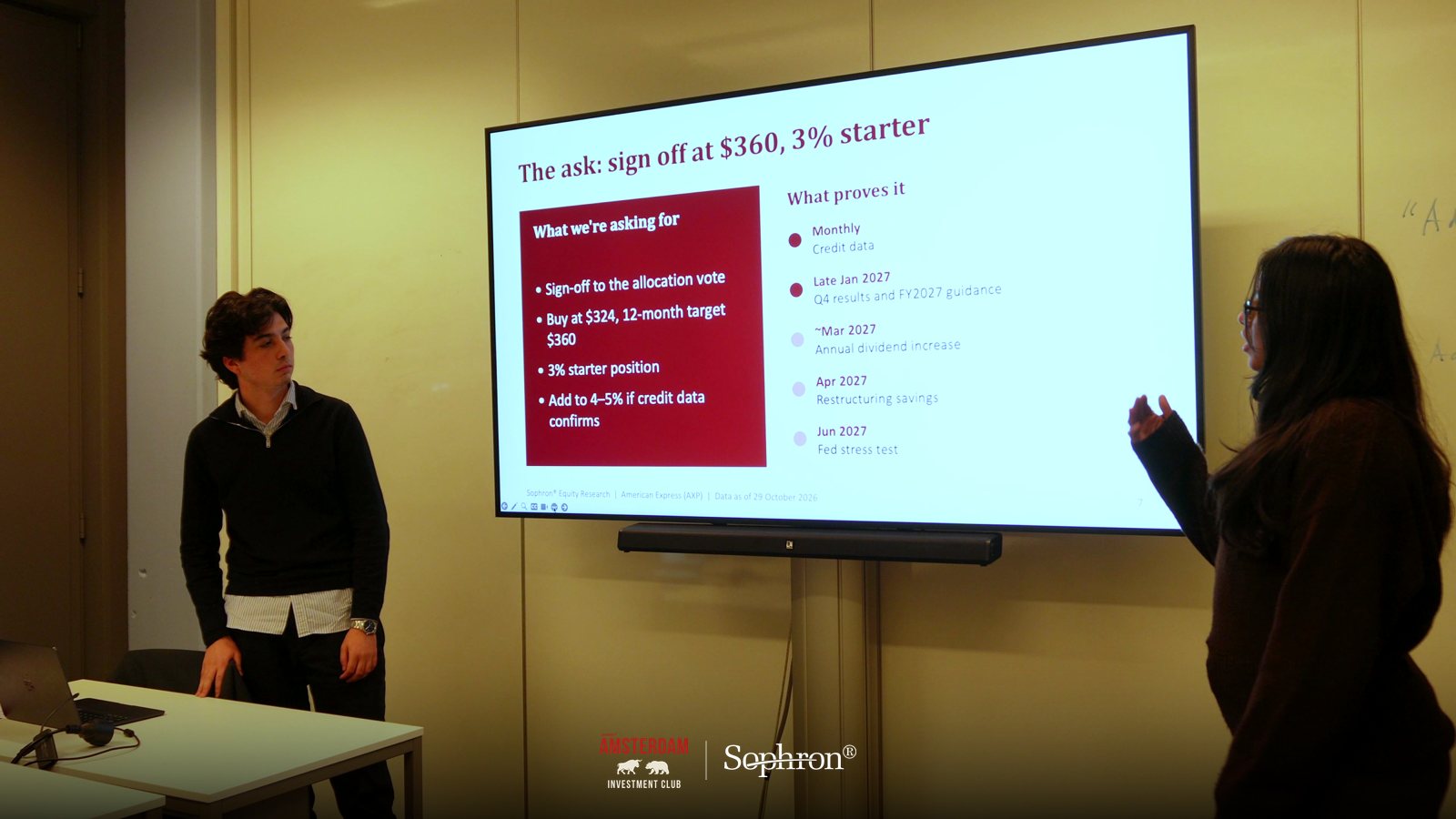
Priced like a credit lender, run like a fee business.
The pitch
- Buy, with a 12-month target of $360 against $324. The desk would start at 3% of the portfolio and add if the numbers come through.
- The market values Amex at about 17 times earnings, close to Capital One, while Visa and Mastercard trade at 27. The desk thinks that is the wrong comparison. Amex beat expectations in seven of the last eight quarters. Three quarters of its revenue is fees, and write-offs are falling.
- A blend of multiples and a DCF gives $360. In a recession the desk sees $283.
Questions from the judges
- You compare Amex with Visa and Mastercard, but you also say its biggest risk is the credit cycle, which they are not exposed to. Is that not exactly why they trade at a higher multiple?Yes. Amex is more exposed to growth and recession than Visa and Mastercard.
- Then should its multiple move closer to theirs? Your DCF says the stock is fairly valued, so the buy case rests on the P/E going up.The desk sees room for the multiple to rise, but not to Visa and Mastercard levels.
- What does Amex charge the people it lends to, as an annual rate?It depends on the card tier, and the membership comes with benefits that keep customers loyal. The judge's reply: that answers retention, not the risk.
- How did you arrive at a 3% position?As a careful start: enough to matter without taking too much risk.
Feedback
- Caps on fees can break a lending business. If defaults run near 5% and a cap comes close to that, the model stops working. Watch China, where fee caps have pushed several lenders into bankruptcy.
- Check whether Amex charges more than its competitors: that may explain why it trades at 17 times earnings and the networks at far more. Look at what each party plans on consumer protection.
- Size from the portfolio, not a round number: for example, financials are about 18% of the world index, so how many financial stocks do you want, and at what weight? And a good presentation.
The Health Care desk holds Doximity
Health Care desk · Manvi Midha (desk head) · Myint Mo Maung Maung
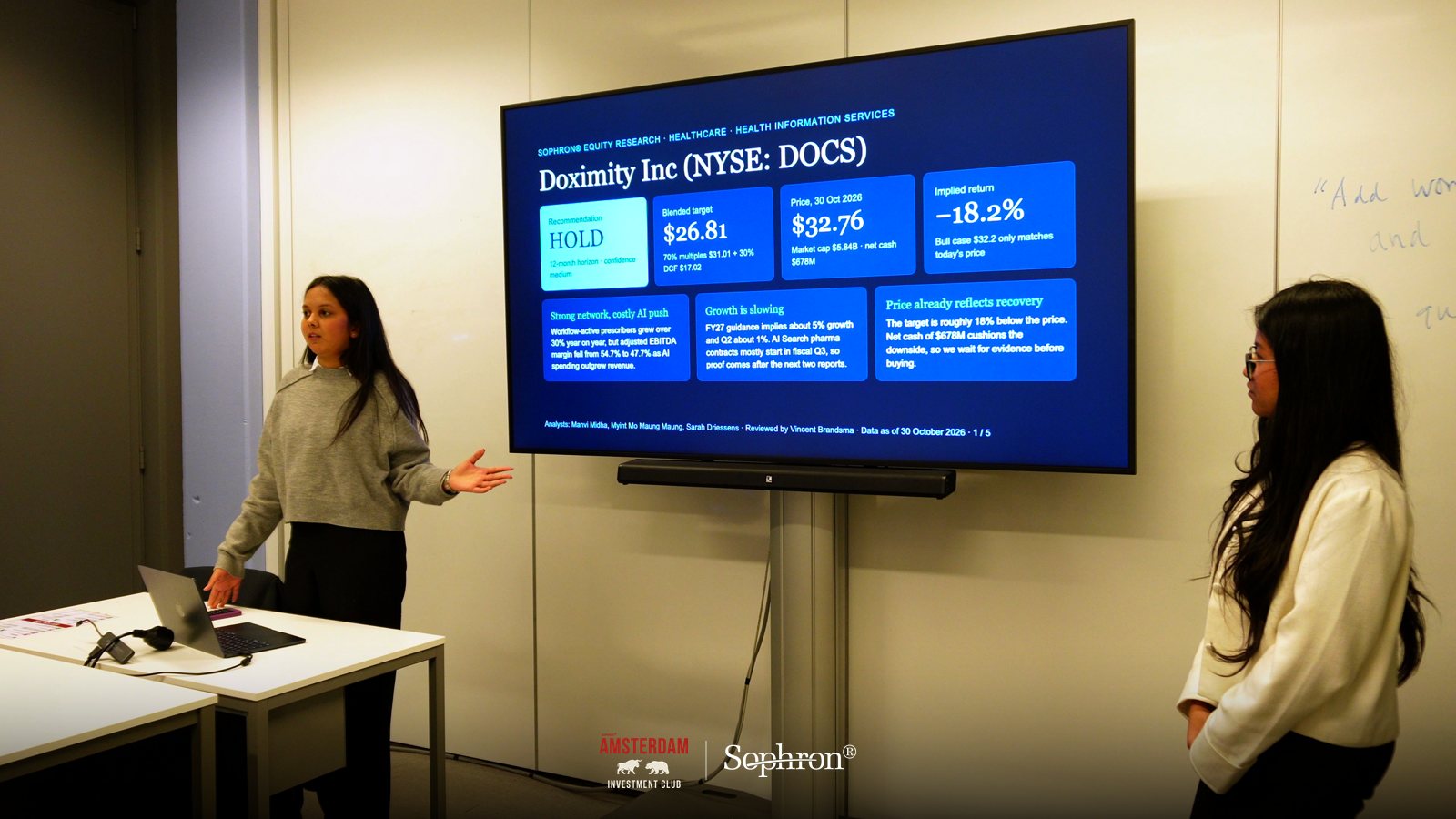
A strong network paying heavily for AI before the AI pays back.
The pitch
- Hold, target $26.81, about 18% below the price of $32.76.
- About 85% of US physicians use Doximity, and 94% of revenue is subscriptions at an 89% gross margin.
- The AI tools launched in April 2026 pushed the adjusted EBITDA margin from 54.7% to 47.7%, and guidance points to growth of about 5%. The pharma contracts for AI search mostly start next quarter, so the proof comes after two more reports.
- Risks: AI competitors pulling physicians away, one customer above 10% of revenue, and AI costs outgrowing revenue.
Questions from the judges
- If I see 20% downside, why is my analyst saying hold?The AI tools have raised costs, and the next results, in February 2027, will show whether they earn money. The network is hard to leave and the company has no debt.
- Which way will AI costs go, and where can margins go?The AI does not earn revenue yet, but $678 million in net cash and no debt give room. There is also a class action alleging that investors were misled, which is a reason for caution, though not for a sell given how many physicians rely on the network.
- Your slides show margins rising while capex stays heavy. How does that work out?Left open for lack of time; the desk offered to send the slides.
Feedback
- If the moat holds and AI does not disrupt it, the company can raise its margins later, so today's multiples say little about what it earns in five years. That is the whole software model.
- The judges liked the format of the report and said the desk was doing a really good job.
The Industrials desk buys Caterpillar, at a small weight
Industrials desk · David Draghici (desk head) · Ilia Tatarnikov · Naisha Mittal · Rainer Schestak
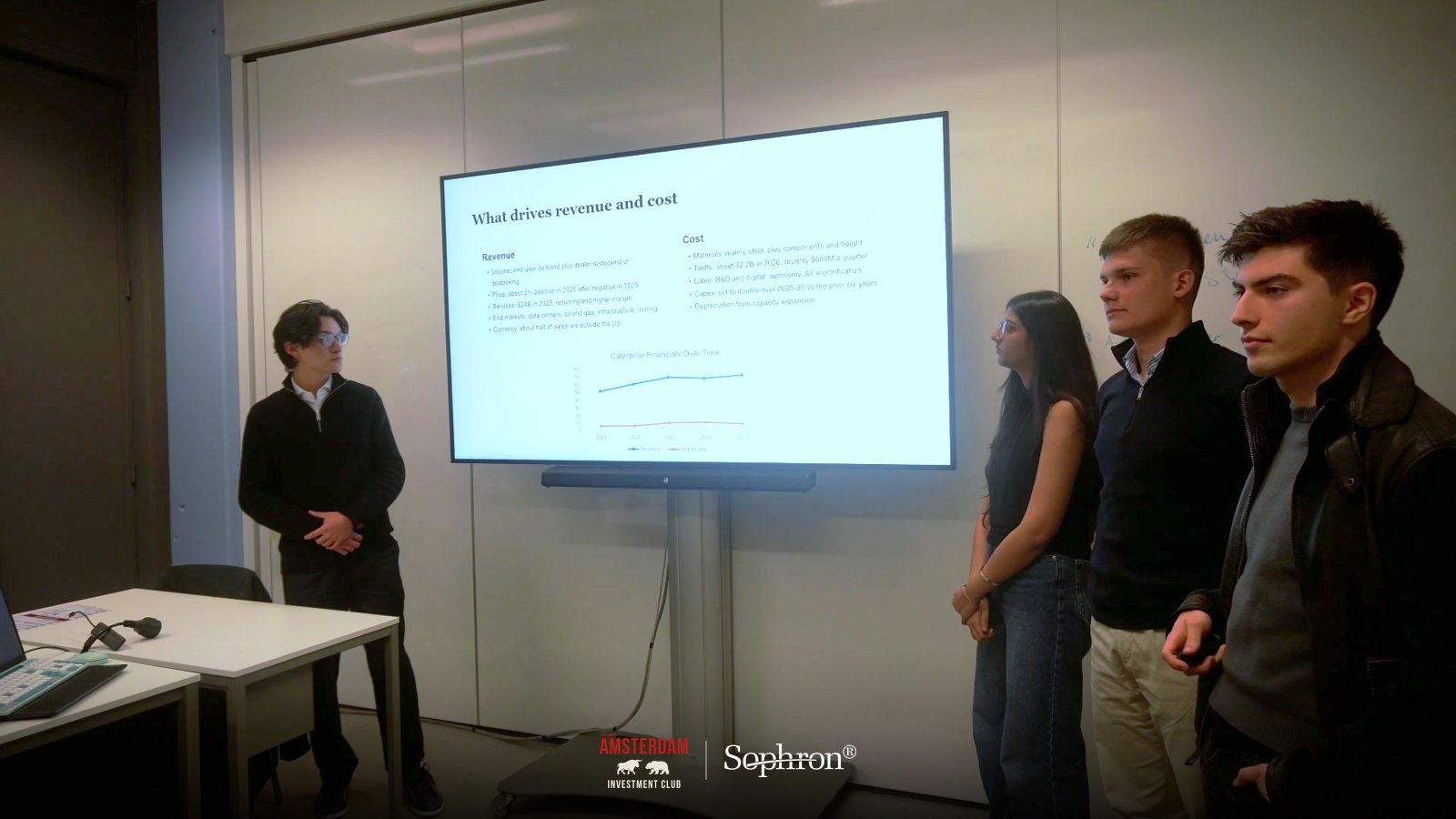
More of a power company than the market gives it credit for.
The pitch
- Buy at a small weight, target $690, about 11% up over 12 months.
- The shares fell after the October results, not because the numbers were poor but because growth slowed against high expectations.
- Power generation grew 32% to $10.3 billion on demand from data centres. Services, which smooth the cycle, should grow from $24 billion in 2025 to $30 billion by 2030. Price rises of about 2% offset some $2.2 billion of tariffs.
- The midterms pull both ways: AI spending could slow, but tariffs could fall.
Questions from the judges
- Your case is that Caterpillar is not just a cyclical machinery company but an AI play. Power is only about a fifth of revenue. Are there not purer ways to own AI in industrials, without the cyclical risk the macro desk warns about?Industrials are cyclical by nature. The desk compared Cummins and GE Vernova, both closer to power, and their multiples differ widely.
- Why is GE Vernova's EV/EBITDA so high?The desk was not sure. The judge's read: its P/E, price to cash flow and price to sales look normal, so the difference sits in enterprise value, which points to debt.
Feedback
- Democrats like tariffs too: they stayed under Biden after the first Trump term, and they help pay for the deficit. Do not count on them falling.
- Ask how much Caterpillar is over-earning in the AI build-out. A shortage lifts margins as well as sales. The question is not today's P/E but what earnings remain after the wave, which is probably less.
- In a downturn, dealers cut stock and service contracts get cancelled, so earnings fall faster than you expect.
The Information Technology desk buys SK Hynix
Information Technology desk · Ágoston Molnár · Sohit Shampalli
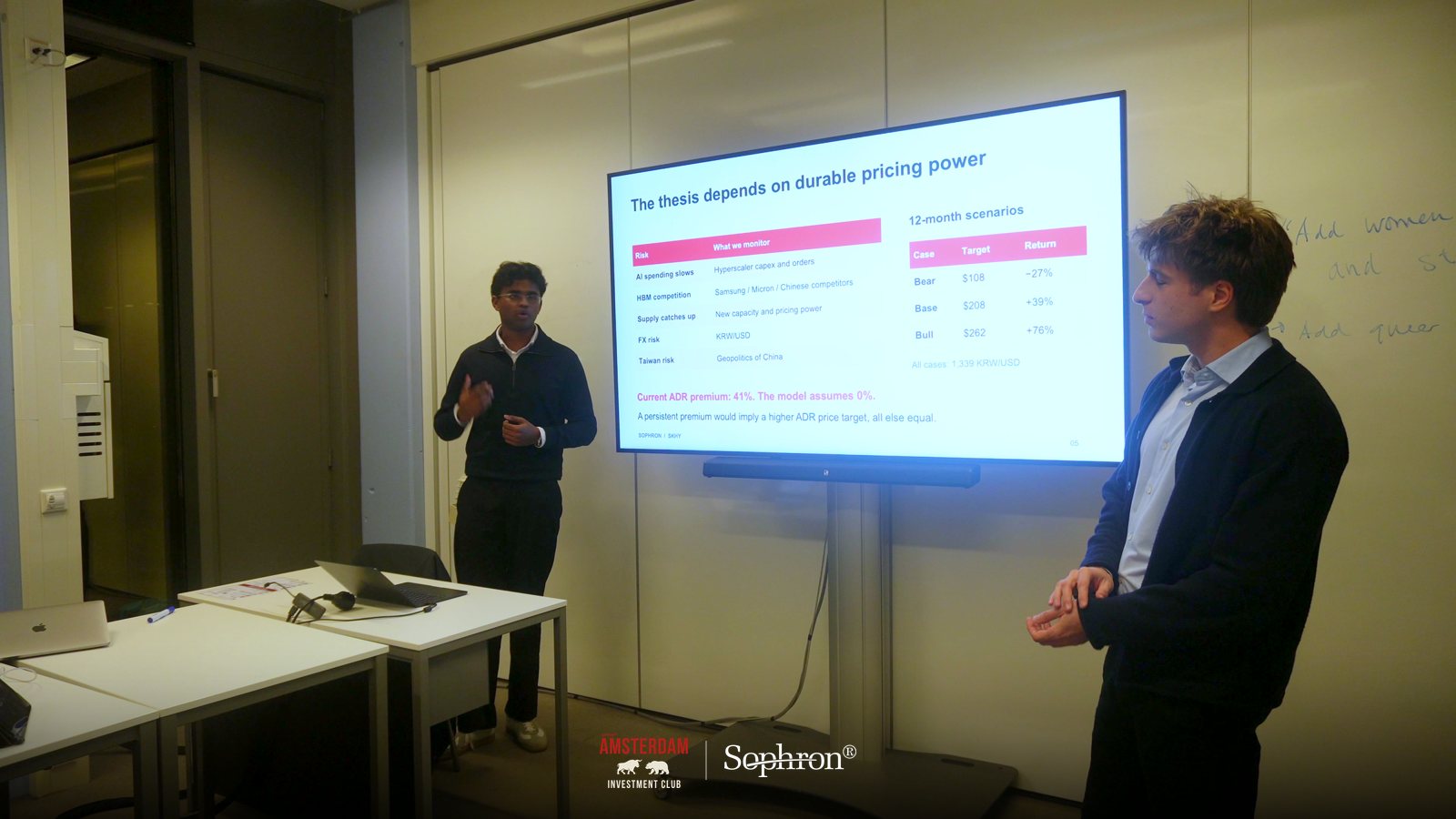
The memory leader in a shortage the buyers expect to last.
The pitch
- Buy, target $208 from about $150, a 39% upside. Bear case $108, bull case $262.
- SK Hynix leads in high bandwidth memory (HBM), the memory in AI chips, and ranks second in DRAM and NAND. Its operating margin reached about 80% last quarter.
- Capacity for 2027 and 2028 is almost sold out to buyers such as Nvidia, Broadcom and AMD, on agreements of five to ten years. The company returns at least half of its free cash flow to shareholders.
- Risks: a slowdown in AI spending, Samsung, Micron and Chinese competitors catching up, the won against the dollar, and tension over Taiwan.
Questions from the judges
- What is the current valuation?The desk quoted a low forward multiple, at about 3 times.
Feedback
- One judge said the desk was "singing my song": SK Hynix is a stock he likes, so he found it hard to ask the tough questions. He called it a really good presentation.
The Materials desk buys Rio Tinto
Materials desk · Cesar Clementin · Romain Garbuio Binaud
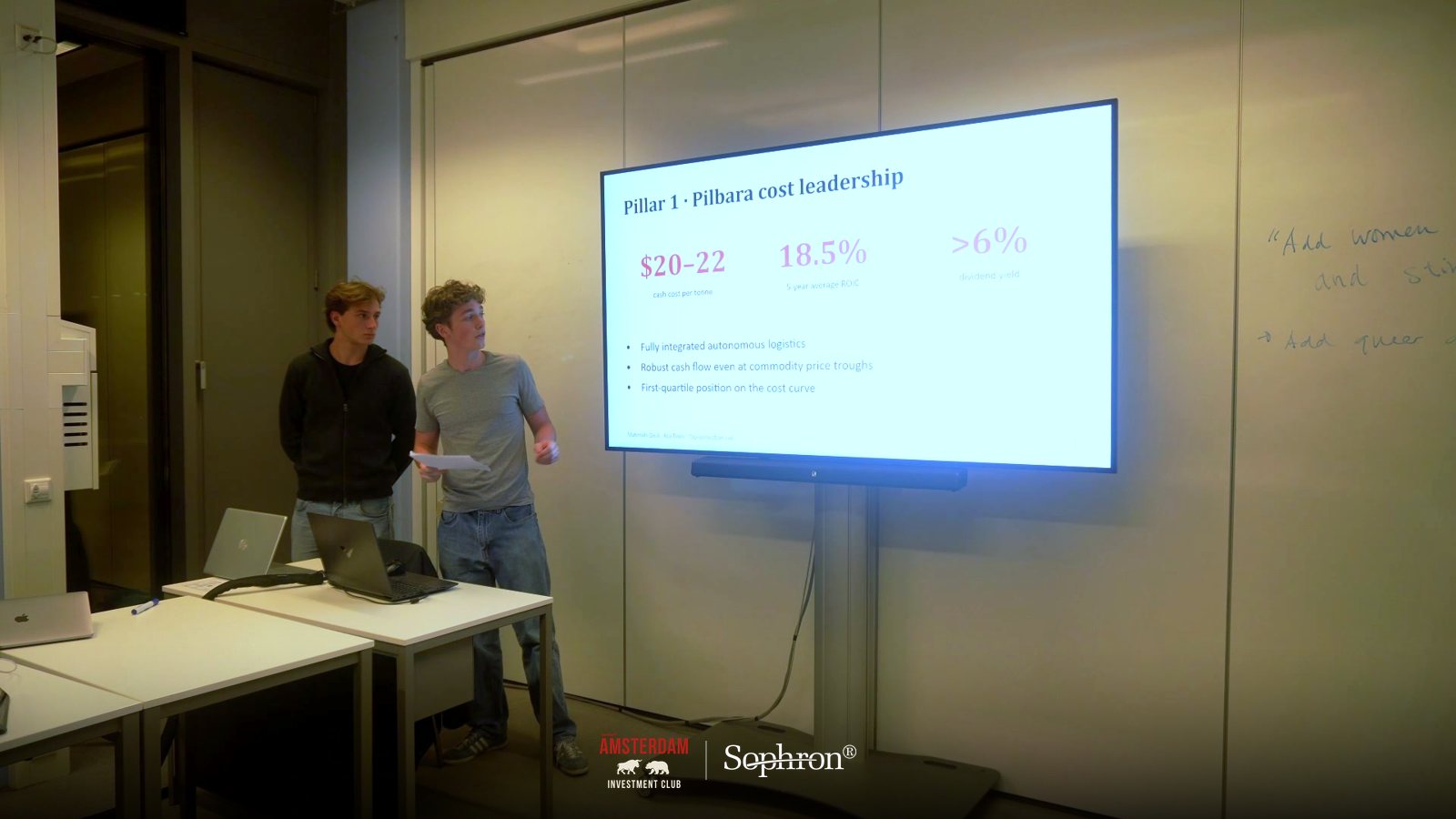
Iron ore cash paying for copper and low-carbon aluminium.
The pitch
- Buy, with a fair value of $82, about 23% above the price, plus a dividend yield above 6%.
- The market watches Chinese property headlines and misses how Pilbara iron ore, produced at $20 to $22 a tonne, funds growth in copper at Oyu Tolgoi and hydro-powered aluminium in Canada. Simandou adds high-grade ore for low-carbon steel.
- Valuation: half a 10-year DCF ($84.50) and half peer multiples ($79.50). If China slows, low costs keep Rio profitable while higher-cost producers cut supply.
Questions from the judges
- The desk asked back: what should we do to value it better?Start from earnings at today's spot prices for the next two or three years, take the average, and watch the stock from there (see the feedback below).
Feedback
- A very nice presentation, and the point about Rio diversifying into copper and aluminium is a good one.
- Be careful with a 10-year DCF on a miner. Mining shares trade on spot commodity prices. You typically buy them when they look expensive, on a high P/E, because earnings are depressed, and sell them when the P/E looks low.
- When spot prices fall, ask why. If the share price falls less than earnings, which happens because mines have high fixed costs, the stock has become better value. That is your trigger to buy, more than any story about value creation.
The Utilities desk holds Duke Energy
Utilities desk · Priyanshu Hota (desk head)
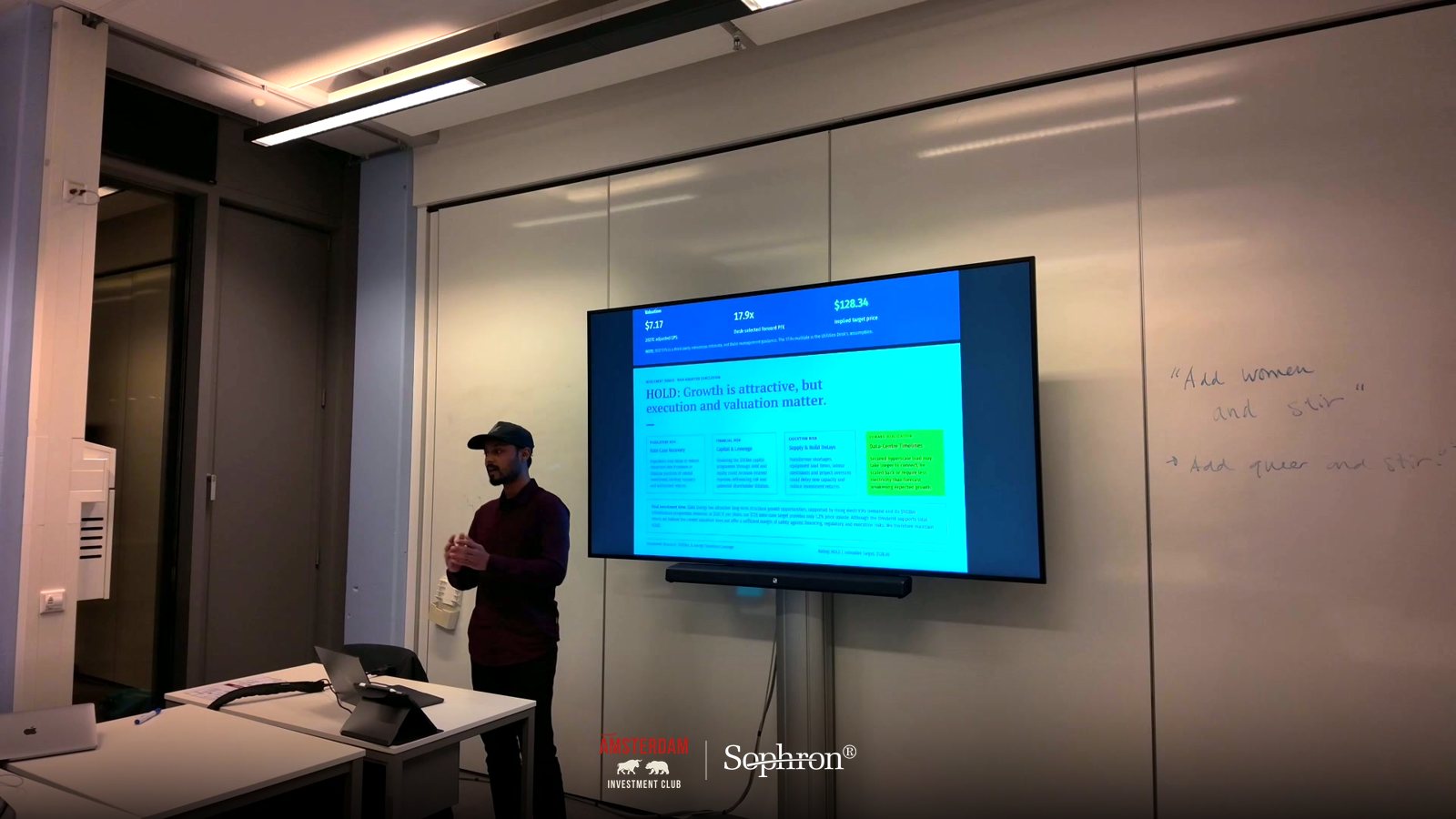
A good business, already priced for it.
The pitch
- Hold, target $128. The report used a price of $126.51; on the evening the shares were already above $130.
- US electricity demand is rising, much of it from data centres, and Duke has signed about 4.5 gigawatts of data-centre load. Signed demand is not yet revenue, though: it depends on how fast those projects come online.
- Duke serves 8.7 million customers, and the regulated model lets investment in the grid earn an approved return. Capex is $103 billion over five years, with management aiming for 5 to 7% EPS growth a year.
- At 17.9 times 2027 earnings of $7.17, there is little upside beyond the 3.4% dividend.
Questions from the judges
- If it is a hold, is it already in the portfolio, or is this a fresh investment case?Not yet: the desk votes on what goes in, and this name has not been through that vote.
- How much debt does Duke carry?Free cash flow has been negative for three or four years, and debt is high, as is normal for a utility building out its grid. Its multiple is above peers such as Southern Company and NextEra.
- Where does it operate, and are those the states where data centres are being built?In six states. It cannot grow much on its own there, so it has been buying companies to expand.
Feedback
- A well-built case for a utility, which is hard to sell to an investment committee. Revenue is regulated, input costs are outside your control and debt is high, so the stock is very sensitive to rates and behaves like a bond. Watch the bond market alongside it.
- A rare case where comparing with peers makes sense, and using a forward P/E rather than a DCF fits a business with negative free cash flow.
What the judges kept coming back to
- Fit the method to the business. Value Alphabet by its parts. Value miners on spot prices, not a 10-year DCF. Compare on P/E only with peers that carry similar debt and growth.
- Say what the market is missing. Rising earnings and a rising multiple are different arguments, and the second needs new buyers.
- Think as a portfolio. One judge asked how the portfolio squares a macro overweight on energy with selling the biggest oil stock. Selling one stock is not going underweight a sector, the desk answered. Position sizes should come from the portfolio, not a round number.
- Update when the facts change. The midterms came up in almost every Q&A, from oil and the Strait of Hormuz to tariffs and AI spending.
After the pitches

The online pitches, 5 November
The next evening the online desk pitched over Zoom: two more calls, each followed by questions and feedback from the Sophron® team.
The Information Technology desk buys Jabil
Information Technology desk · Nia Petseva (desk head) · Alex Emmerig · Ethan Raphael
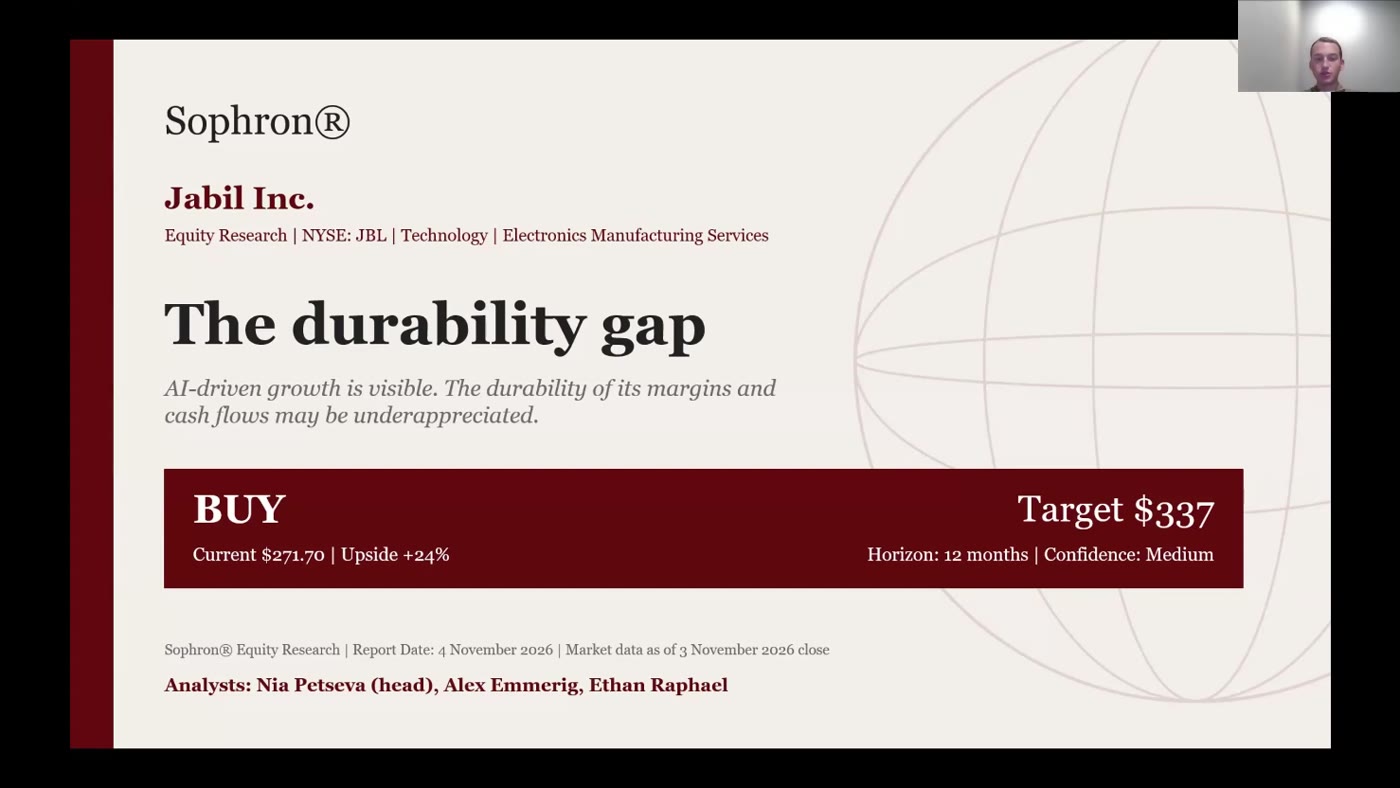
AI growth is visible; the durability of its margins and cash flows is not yet priced.
The pitch
- Buy, target $337, about 24% above the price of $272.
- Jabil builds products for other companies: AI server racks, car electronics, medical devices and warehouse robots. Management guides AI-related revenue from $14.4 billion to $22.1 billion next year, up 54%, against 24% for the business as a whole, helped by power and liquid cooling since the Hanley acquisition.
- Not only an AI bet: regulated industries such as health care and automotive are about 35% of revenue, on programmes that run ten years or more. The desk expects the operating margin to rise from 5.8% to 6.3% in two years and rates the moat narrow: process power, switching costs and scale, but large customers can move.
- Valuation: 60% on a DCF ($334, cost of capital 9.9%, terminal growth 3%, margins back to 6% in the long run) and 40% on the sum of the parts ($342). Free cash flow of $1.49 billion against management's $1.6 billion, because the working capital the growth needs is charged in full.
- Every risk priced in dollars: slower AI spending ($33), customer concentration ($45), cash conversion ($11). Bear case $193, bull case $437, weighted $333.
Questions
- What happens to Jabil in the long run if AI ends up needing far less infrastructure?It would be hit, as most of the growth now comes from AI, but less than pure AI companies: health care, automotive and defence cushion it, and the business was profitable before the AI segment grew.
- In the sum of the parts, why do regulated industries get a higher multiple than intelligent infrastructure?Left open: that part of the model was a teammate's.
- The bear and bull cases are more than twice apart. Where does the $193 come from?Every risk at once plus some more, on a business that is now very sensitive to its AI segment: a deliberate worst case.
- Would you buy it with your own money?The desk was unsure, not least because the share had fallen about 10% since the date of its data.
Feedback
- In a sum of the parts, know why each part gets its multiple: that shows where the value sits, and where a company could be overvalued.
- Everyone on the desk should be able to answer for the whole model, not only their own section.
- Explain the extremes in one line each, and walk through what happens to the shares if AI spending keeps rising, flattens or falls.
The Health Care desk holds Doximity, online
Health Care desk · pitched online by Sarah Driessens; Manvi Midha and Myint Mo Maung Maung pitched the same call in the room (above)
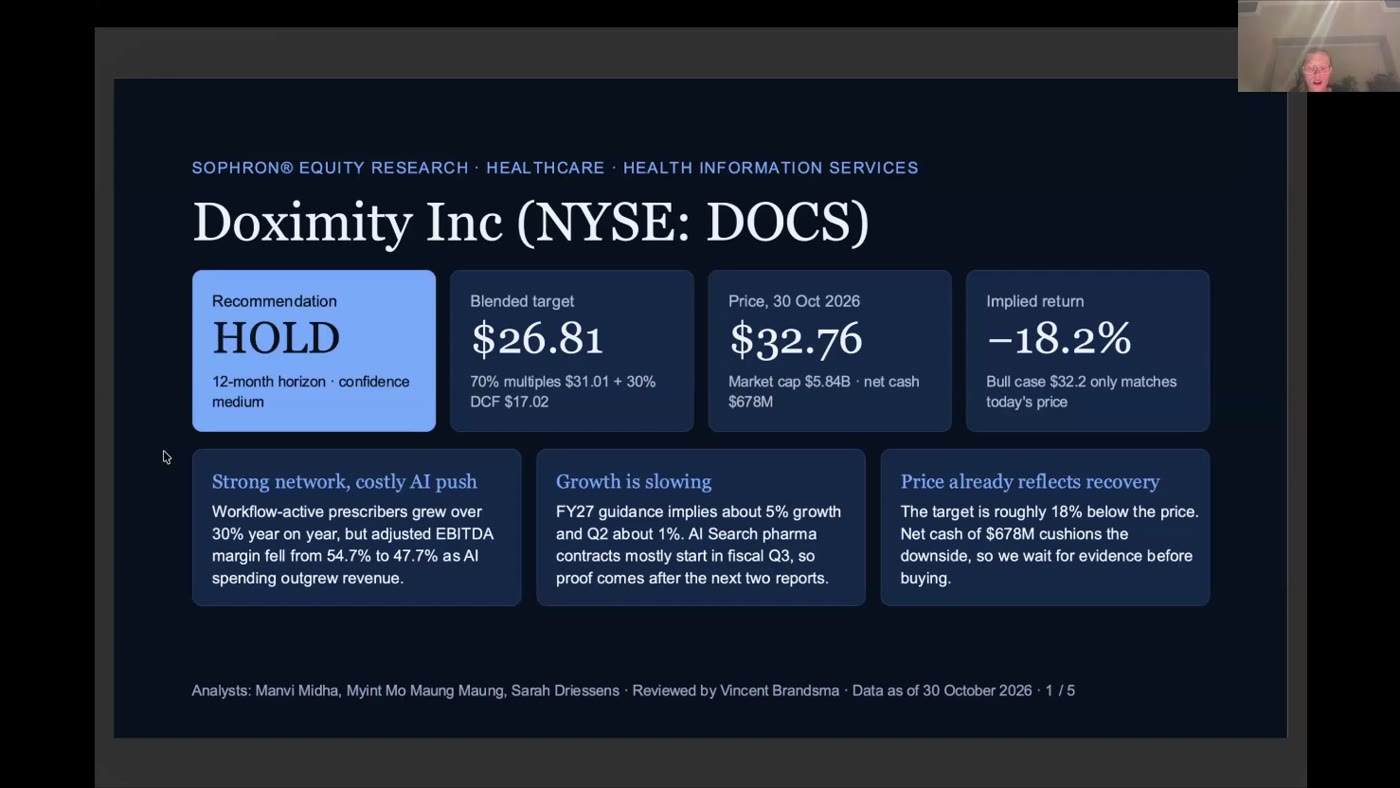
A strong network, paying for AI before the AI pays back.
The pitch
- Hold, target $26.81, about 18% below the price of $32.76.
- More than 85% of US physicians are verified members and about 90% of graduating US medical students join. Pharma pays to reach them (Marketing Solutions); hospitals pay to hire through it; the workflow tools are free for physicians.
- AI search launched in April: workflow prescribers grew more than 30% year on year and the top 20 pharma companies signed their first AI deals. The cost shows first: the adjusted EBITDA margin fell from 54.7% to 47.7%.
- Revenue of $644.9 million at an 89% gross margin, with guidance pointing to growth of about 4 to 6%. Valuation: 70% on multiples ($31.01) and 30% on a DCF ($17.02).
- Risks: AI-driven competitors such as OpenEvidence, LinkedIn and Medscape, one customer above 10% of revenue on short pharma contracts, and AI costs outgrowing revenue.
Questions
- With margins falling, why a hold and not a sell?The AI search may still pay back; selling now would give up that upside.
- Where does the advantage nobody can copy come from: the data, or the platform?The network: almost every US physician is on it.
- Will the spending on AI outgrow the profits?Not yet clear; the next reports will show whether AI search earns its cost.
Feedback
- Today AI mostly saves costs rather than earning new revenue. For Doximity the bear case is exactly that question: is it worth spending this much on AI search?
- Give the hold a trigger: the number that would turn it into a buy or a sell.
- Explain why the DCF ($17) sits so far below the multiples ($31).
What happens next
Each desk now files its final report, and the desk votes on which names go into the portfolio at the Allocation session. The Winter cycle starts on 9 November, with new teams and the next round of pitches in the new year.
Want to pitch at the next one? The Sophron® Analyst Program runs in Amsterdam and online. See how the program works.