About Clement Chang

Clement Chang passed the CFA Program Level I exam in June 2025, while studying for his BSc in Economics and Business Economics at the University of Amsterdam. He is now a Level II candidate and is doing his master's in Accounting and Financial Management at Rotterdam School of Management.
In the Sophron® Analyst Program he worked as an equity research analyst and as portfolio manager of the analyst desk. Alongside his master's he is taking part in the CFA Institute Research Challenge for RSM.
The conversation
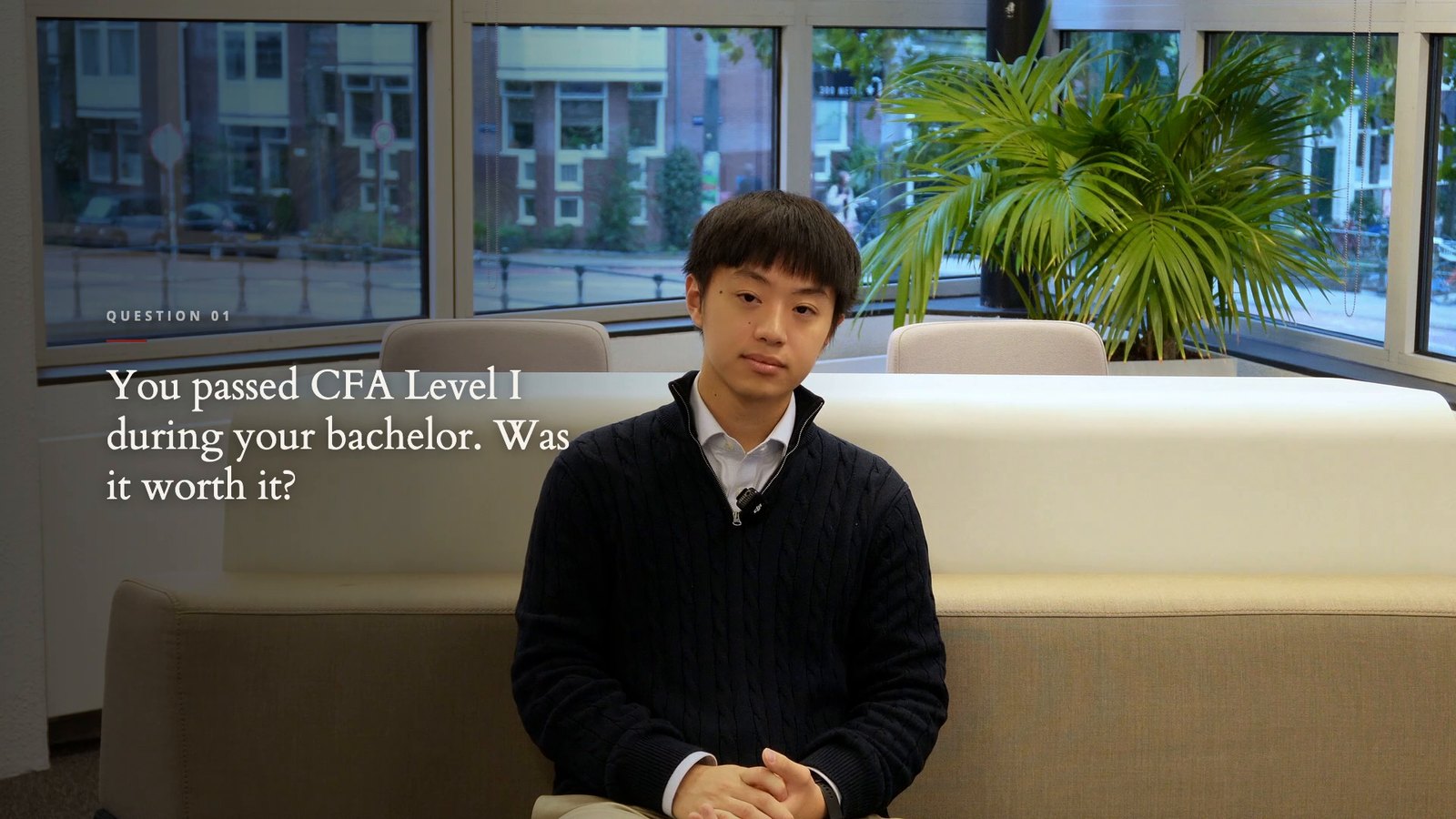
Was passing Level I during your bachelor worth it?
Yes, but not as a direct route into an internship.
- It gets you into places and builds connections. It also gives you common ground for conversations with people in the industry.
- It shows you how the investment world works, beyond the models and theories taught at university.
- It does not go deep into the day-to-day work. For practical skills he points to internships and investment clubs.
What does nobody tell you before you sign up?
It is less about how hard the material is and more about persistence.
- Completing all three levels and the charter takes three to four years or more.
- One level alone takes several months of preparation, next to work, studies and a social life.
- For him the hardest part was managing his time while still having a social life and doing internships.
How is Level II different from Level I?
Level I builds the foundation. Level II asks you to apply it.
- Level I gives you the basics of how investments work, especially on the asset management and portfolio management side.
- Level II is about calculations and valuation. The questions come in vignettes: sets of questions built around one scenario.
- The hard part is knowing why and how, including the assumptions, not only what. Level II takes more preparation time and more effort.
Is the bachelor the right time to start?
Only if you are sure about the career path it leads to.
- He started during his bachelor because he already knew he wanted to work in asset management, portfolio management or equity research.
- For most bachelor students he would start with an investment club or an internship. Experience and connections matter more than the CFA Program on its own.
Which study materials did you use?
A third-party provider, and the videos rather than the books.
- He used Kaplan, one of the well-known exam prep providers, mainly for its module videos.
- Going through the videos was quicker for him than reading the official books, which run to thousands of pages.
- In his view a third-party provider saves a lot of time and effort and makes the concepts easier to follow.
How many hours did you spend preparing?
Around 250 to 280 hours for Level I, against the official guide of about 300.
- CFA Institute's guide is about 300 hours of preparation for each level.
- His bachelor was in a related field, which let him cut the time a little, to around 250 to 280 hours.
- How much you need depends on your background: a finance or accounting degree, or work experience in the field, saves time. Expect about 300 hours for Level I and more for Level II.
What was exam day like?
Calm, quiet and much like any official exam.
- He sat Level I in Amsterdam, near where he lives, so the venue was familiar.
- You register, then sit at a computer for about four hours, with a 30-minute break between the two parts of the exam.
- The room was quiet and people were trying to stay calm. He expects it to be much the same at any test centre.
Which topics can you expect?
Ten topics at Level I, with ethics the one people talk about most.
- The hardest for him was financial statement analysis: accounting basics, accounting principles and a lot of formulas to memorise.
- The most interesting is ethics. CFA Institute has its own principles and rules, and candidates are bound by them once they register.
- Ethics carries a large share of the exam and is not about calculations, which is why candidates practise so many ethics questions.
- Beyond ethics, expect a lot of valuation, measurement and calculation.
Do recruiters care about Level I?
It gets you interviews. The interview gets you the job.
- Level I gives an advantage for entry-level jobs and internships, but it is a misconception that it lands you the job.
- At most it gets you into interviews. In his estimate, 70 to 80 percent of whether you get the job depends on the interviews themselves.
- Recruiters value it because it shows commitment and a basic understanding of the field. The practical side still comes from experience and student clubs.
Any last tips for students?
Be sure you are committed, and get your expectations right first.
- The CFA Program costs time, effort and money over several years, next to your work or studies.
- Before you start, talk to people who are doing the program or who already hold the charter, and ask how it helps in their jobs.
Sources and further reading
- CFA® ProgramThe three levels, exam windows, fees and the official study time guidance, from CFA Institute. cfainstitute.org/programs/cfa-program
- CFA Institute Research ChallengeThe equity research competition for university teams that Clement is taking part in for RSM. cfainstitute.org/insights/events/research-challenge
- Kaplan SchweserThe exam prep provider whose module videos Clement used for Level I. schweser.com
- CFA Program guide for studentsOur step-by-step guide to starting the CFA Program as a student in the Netherlands, including the student scholarship. amsterdaminvestmentclub.com/cfa
Sophron is an independent party that uses educational content and learning resources from CFA Institute, the global association of investment professionals.
CFA® and Chartered Financial Analyst® are registered trademarks owned by CFA Institute.